







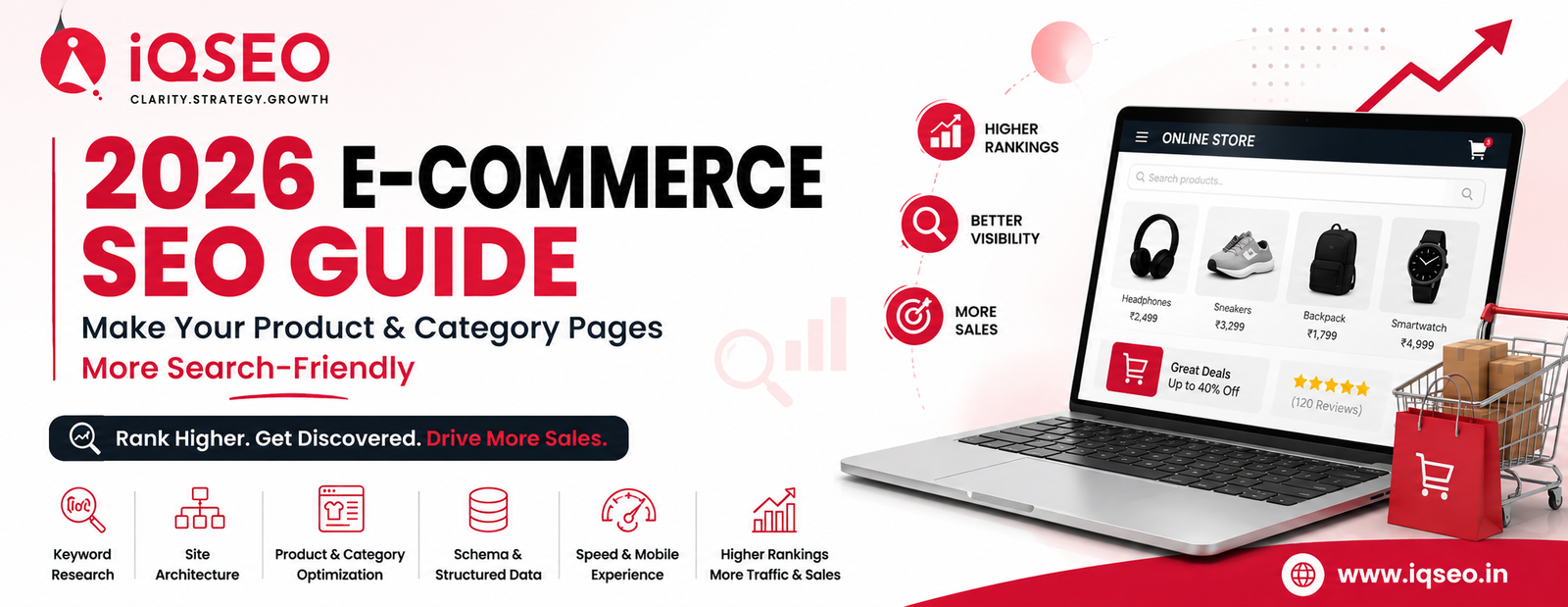
E-commerce SEO has become more competitive in 2026. With thousands of online stores targeting the same commercial keywords, simply adding products and writing basic descriptions is no longer enough. Search engines need to understand your website structure, products, categories, variations, content, and overall relevance before deciding which pages deserve visibility.
For online stores, category pages and product pages are two of the most important assets for generating organic traffic and sales. Category pages can target broader commercial searches, while product pages capture users who are closer to making a purchase.
A strong e-commerce SEO strategy connects both page types through technical SEO, keyword targeting, useful content, internal linking, structured data, and a crawl-friendly website architecture.
This E-commerce SEO checklist for 2026 covers the essential steps businesses can use to improve product and category page visibility and build a stronger organic search presence.
1. Begin With Keyword Research and Search Intent
Before optimizing a category or product page, identify what potential customers are actually searching for.
Category pages should generally target broader commercial keywords, while product pages should focus on specific product-related searches.
For example:
Category keyword:
-
Running Shoes
-
Men's Running Shoes
-
Wireless Headphones
Product keywords:
-
Nike Air Zoom Pegasus 41
-
Sony WH-1000XM5
-
Samsung Galaxy S26 256GB
Do not force the same primary keyword onto multiple pages. Each important page should have a clear keyword target and search intent.
Look at competitor pages, related searches, long-tail keywords, product attributes, and questions customers use during the buying journey. This helps create a keyword map where every important category and product has a defined SEO purpose.
2. Build a Clear E-commerce Site Architecture
Your website structure should make it easy for both shoppers and search engines to discover important pages.
A simple structure could look like:
Homepage → Category → Subcategory → Product
For example:
Home → Shoes → Men's Shoes → Running Shoes → Product
Google explains that it uses the relationships between pages and internal links to understand the structure and relative importance of ecommerce content. Category pages should link to relevant products, and important products should be reachable through normal crawlable navigation.
Avoid creating important product pages that can only be discovered through an internal search box. Googlebot generally does not submit searches into website search forms during crawling.
3. Improve Category Page Titles and Meta Descriptions
Your category page title should clearly communicate the product category and target keyword.
Instead of:
Products | Brand Name
Use something more descriptive:
Men's Running Shoes Online | Lightweight & Comfortable Shoes
Your meta description should explain what shoppers can find on the page while naturally including relevant terms.
Avoid keyword stuffing. The objective is to make the title and description useful to users while accurately representing the page.
4. Create Helpful Category Page Content
A category page should not be just a grid of product images.
Add useful introductory content explaining what the category offers, who the products are for, important features, buying considerations, and relevant product attributes.
For example, a running shoe category could explain:
-
Different types of running shoes
-
Road vs. trail running shoes
-
Cushioning and support
-
Choosing the correct size
-
Suitable use cases
The content should support the shopping journey rather than simply adding paragraphs to increase word count.
Google's ecommerce guidance emphasizes creating useful content and making important products accessible through site navigation.
5. Optimize Product Page SEO Elements
Every important product page should have unique and descriptive SEO elements.
Check the following:
-
Unique title tag
-
Compelling meta description
-
One clear H1
-
Descriptive product description
-
Optimized product images
-
Product specifications
-
Price and availability
-
Reviews where applicable
-
Shipping and return information
-
Relevant internal links
-
Appropriate structured data
Avoid copying manufacturer descriptions across hundreds of products. Duplicate descriptions make it difficult for your pages to demonstrate unique value.
Instead, create product content that explains benefits, specifications, use cases, compatibility, and other information that helps customers make a purchase decision.
6. Use Product Structured Data
Structured data makes it easier for search engines to understand ecommerce content.
For ecommerce websites, Google identifies several useful structured data types, including Product, ProductGroup, BreadcrumbList, Organization, Review, and VideoObject.
Product structured data can communicate information such as:
-
Product name
-
Brand
-
Image
-
Description
-
Price
-
Availability
-
Reviews
-
Ratings
-
Product identifiers
Google states that Product structured data can make product pages eligible for enhanced search appearances containing information such as price, availability, and review details.
For ecommerce stores with multiple product variants, such as different colors, sizes, or configurations, ProductGroup and appropriate variant markup can help Google understand the relationships between those variants.
Always ensure your structured data accurately represents the visible information on the page.
7. Fix Product Variant and Canonical URL Issues
E-commerce websites often create multiple URLs for the same product because of color, size, filters, sorting, or other parameters.
For example:
/shoes/product
/shoes/product?color=black
/shoes/product?size=10
Without proper URL management, search engines may encounter duplicate or near-duplicate versions of the same content.
Google recommends using consistent URLs across internal links, sitemaps, and canonical tags. For variant pages, the URL structure should clearly identify the variant when separate URLs are used.
Review your canonical implementation carefully and make sure important indexable pages are not accidentally canonicalized to unrelated URLs.
8. Control Faceted Navigation
Filters such as:
-
Brand
-
Size
-
Color
-
Price
-
Material
-
Rating
-
Style
can improve user experience but may create thousands or even millions of URL combinations.
For example:
/shoes?color=black&size=10
/shoes?color=black&size=10&brand=nike
These URLs can create unnecessary crawling and indexing problems.
Google specifically identifies faceted navigation as a common source of overcrawling because filter combinations can generate huge numbers of URLs.
Decide which filtered pages have genuine search demand and SEO value. Allow valuable combinations to be crawlable when appropriate, while controlling unnecessary variations through your technical SEO strategy.
9. Strengthen Internal Linking
Internal links distribute authority throughout your website and help search engines discover important pages.
Link:
Homepage → Main Categories
Categories → Subcategories
Subcategories → Products
Products → Related Products
You can also use blog content to link naturally to commercial category and product pages.
For example, a blog about "How to Choose Running Shoes" could link to your running shoe category.
Use descriptive anchor text rather than generic phrases such as "click here."
Google's ecommerce documentation notes that the number and relationships of internal links can help Google understand which pages are important within a site.
10. Optimize Product Images
Images are critical for ecommerce websites because customers rely heavily on visuals when evaluating products.
Optimize:
-
Image file size
-
Image dimensions
-
File names
-
Alt text
-
Image formats
-
Lazy loading where appropriate
-
Mobile display
Use descriptive image names instead of generic filenames such as:
IMG12345.jpg
A better example would be:
black-running-shoes-men.jpg
Google also provides ecommerce guidance for product discovery across Google Search, Images, and Google Lens.
11. Improve Mobile Experience and Page Speed
A slow ecommerce website can negatively affect both user experience and conversions.
Check:
-
Largest Contentful Paint
-
Interaction to Next Paint
-
Cumulative Layout Shift
-
JavaScript execution
-
Image loading
-
Server response time
-
Mobile usability
Avoid loading unnecessary scripts, oversized images, and excessive third-party applications.
For category pages with hundreds of products, consider how products are loaded as users scroll or paginate. Google notes that incremental loading can improve user experience, but the implementation should still allow crawlers to discover the underlying content.
12. Optimize Breadcrumbs
Breadcrumbs help users understand where they are within your website.
Example:
Home → Electronics → Headphones → Wireless Headphones → Product
Implement visible breadcrumbs and use BreadcrumbList structured data where appropriate.
This reinforces your ecommerce hierarchy and can help search engines better understand page relationships.
13. Connect Google Merchant Center With Your SEO Strategy
Organic SEO should not operate separately from your product data.
Make sure important product information such as:
-
Price
-
Availability
-
Product title
-
Images
-
Brand
-
Product identifiers
-
Shipping information
-
Return information
is accurate and consistent.
Google provides ecommerce guidance for sharing product data and appearing across different Google surfaces, including Search, Images, and Google Lens.
Keeping website content, structured data, and product feeds aligned can create a stronger product discovery ecosystem.
14. Build Trust With Reviews and Helpful Information
Reviews can play an important role in ecommerce decision-making.
Encourage genuine customer reviews and display them clearly on relevant product pages.
Also provide important information such as:
-
Shipping details
-
Returns and refunds
-
Warranty
-
Payment options
-
Customer support
-
Contact information
These elements can improve customer confidence and make product pages more useful.
Do not create fake reviews or manipulate ratings. Trust is an important part of building a sustainable ecommerce brand.
15. Monitor Indexing and Search Performance
SEO is not finished when a page is published.
Use Google Search Console and your analytics platform to monitor:
-
Indexed pages
-
Impressions
-
Clicks
-
CTR
-
Average position
-
Product page performance
-
Category page performance
-
Crawling issues
-
Search queries
Identify pages receiving impressions but few clicks. These pages may need better titles and meta descriptions.
If a page receives little visibility, investigate its keyword targeting, internal links, content quality, indexability, and technical implementation.
E-commerce SEO Checklist 2026
Before considering your store optimized, check these essential areas:
-
Conduct keyword research based on search intent
-
Create a clear category and product hierarchy
-
Optimize category title tags and meta descriptions
-
Write useful category content
-
Create unique product descriptions
-
Optimize H1 and heading structure
-
Implement Product structured data
-
Implement ProductGroup markup for relevant variants
-
Add BreadcrumbList structured data
-
Fix canonical URL issues
-
Control unnecessary faceted URLs
-
Strengthen internal linking
-
Optimize product images
-
Improve mobile performance
-
Monitor Core Web Vitals
-
Optimize pagination and product loading
-
Maintain accurate product information
-
Connect product data with Google Merchant Center
-
Encourage genuine customer reviews
-
Monitor Google Search Console regularly
Final Thoughts
Ranking ecommerce pages in 2026 requires more than adding keywords to product titles. Search visibility depends on how effectively your website combines technical SEO, content quality, site architecture, internal linking, structured data, product information, and user experience.
Category pages should establish strong topical relevance and guide shoppers toward the right products. Product pages should provide detailed, original information that answers purchase-related questions and makes the buying decision easier.
At the same time, technical issues such as duplicate URLs, uncontrolled filters, weak internal linking, slow pages, and incorrect structured data can prevent even well-written pages from performing effectively.
For ecommerce brands using Shopify, WooCommerce, Magento, or custom platforms, a structured SEO strategy can help turn product and category pages into consistent sources of qualified organic traffic.
At IQSEO, we provide ecommerce SEO solutions focused on improving product visibility, optimizing category pages, strengthening technical SEO, and generating qualified organic traffic for online stores. Our approach supports platforms including Shopify, WooCommerce, and Magento while combining proven SEO fundamentals with modern AI-focused search strategies.
If your ecommerce website is generating products faster than it is generating organic traffic, 2026 is the right time to audit your category architecture, product pages, technical SEO, and search visibility.
Frequently Asked Questions
1. What is e-commerce SEO in 2026?
E-commerce SEO is the process of optimizing an online store’s product pages, category pages, site architecture, content, technical elements, and structured data to improve organic search visibility and attract qualified customers.
2. Why are category pages important for e-commerce SEO?
Category pages target broader commercial keywords and help search engines understand the structure and topical relevance of an online store. Well-optimized category pages can attract users searching for product types, brands, features, and specific product categories.
3. How can I optimize product pages for SEO?
Optimize product titles, descriptions, headings, images, URLs, internal links, structured data, reviews, pricing, availability, and other product information. Creating unique, helpful content instead of copying manufacturer descriptions can also improve the page's overall value.
4. What is Product structured data in e-commerce SEO?
Product structured data is markup that helps search engines understand important product information such as name, brand, image, price, availability, reviews, and ratings. When implemented correctly, it can make eligible product pages appear with enhanced search results.
5. How do I prevent duplicate URLs on an e-commerce website?
Use a consistent URL structure, appropriate canonical tags, controlled faceted navigation, and proper handling of product variants and URL parameters. Regularly audit your website to identify duplicate or near-duplicate pages that may create crawling and indexing issues.
6. How long does it take to see results from e-commerce SEO?
SEO results vary depending on website authority, competition, technical condition, content quality, keyword difficulty, and the effectiveness of the overall strategy. Regular monitoring through Google Search Console and analytics can help identify improvements and areas that require further optimization.