






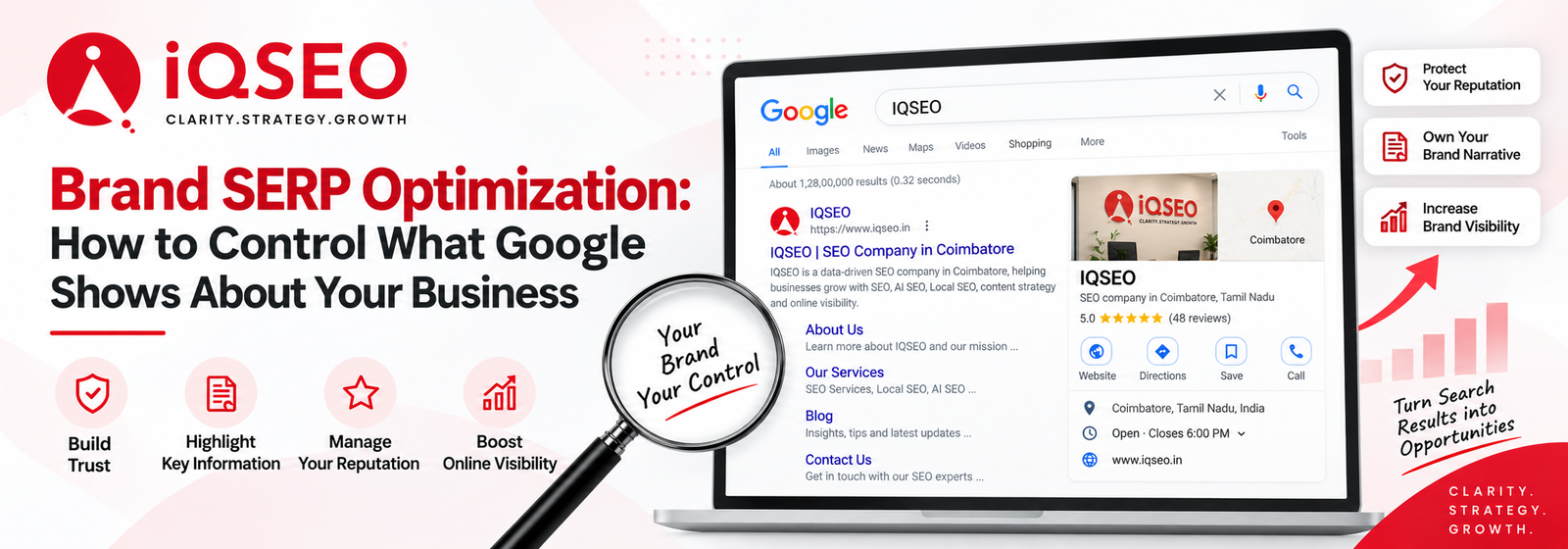
When someone searches your brand name on Google, what do they see?
Your website at the top?
Your social media profiles?
A Google Business Profile?
Reviews?
Random directory listings?
Old information?
Or, worse, someone else's business?
Most businesses spend a lot of time trying to rank for keywords such as SEO company, digital marketing agency, or best web development company. But there is another search result that deserves just as much attention: your Brand SERP.
A Brand SERP is the search results page that appears when someone searches specifically for your business or brand name.
For example, when a potential customer searches for your company, you want the results to immediately communicate:
Who you are → What you do → Where you operate → What customers think → Why they should trust you.
This is where Brand SERP Optimization becomes important.
At IQSEO, we look at brand visibility beyond traditional rankings. The goal isn't simply to rank your homepage for your company name. It's to build a consistent digital footprint that helps Google and your customers understand your brand clearly.
What Is Brand SERP Optimization?
Brand SERP Optimization is the process of improving and managing the search results that appear when people search for your brand name.
It involves optimizing the different assets Google may associate with your business, including:
-
Your official website
-
Homepage title and description
-
Google Business Profile
-
Knowledge Panel
-
Social media profiles
-
Review platforms
-
Business directories
-
Authoritative third-party websites
-
Brand mentions
-
Images and videos
-
Company profiles
-
Relevant blog content
-
Structured data
The objective is simple:
Make your brand's search results accurate, trustworthy, useful, and consistent.
You cannot manually decide exactly what Google will display. Google generates search results automatically based on many signals and sources. But you can give Google better information and strengthen the signals that help it understand your business.
Why Your Brand SERP Matters
Imagine someone hears about your company from a friend.
Before contacting you, they search:
"Your Brand Name"
This is often a high-intent search.
They already know your name. Now they're trying to decide whether they can trust you.
If the search results show a professional website, positive reviews, active social profiles, useful content, and consistent company information, your brand immediately looks more credible.
But if they find:
-
An outdated website
-
Incorrect business information
-
Poor reviews with no response
-
Empty social profiles
-
Conflicting company descriptions
-
Unrelated websites ranking for your brand
-
Old articles
-
Duplicate listings
you may lose trust before the person even visits your website.
That's why Brand SERP optimization isn't just an SEO exercise.
It's reputation management, entity optimization, and conversion optimization combined.
What Appears in a Brand SERP?
Every brand SERP is different, but you may see several types of results.
1. Your Homepage
Your official website will usually be one of the most important results for your brand name.
Your title should clearly communicate your business.
Instead of something vague like:
Home | Company Name
you can provide clearer information such as:
IQSEO – SEO Company & Digital Marketing Experts
The exact wording depends on your brand strategy, but your title should help both users and search engines understand what your company represents.
2. Sitelinks
Google may display additional links underneath your main website result.
These could include:
-
About
-
Services
-
Contact
-
Blog
-
Case Studies
-
Pricing
Sitelinks can make your brand result much more useful because users can jump directly to important pages.
You don't manually select every sitelink Google displays, but a clear website structure, descriptive internal links, and logical navigation can help Google understand your site.
3. Google Business Profile
For businesses with a physical location or service area, the Google Business Profile can be a major part of the brand search experience.
It can include information such as:
-
Business name
-
Category
-
Location
-
Phone number
-
Website
-
Opening hours
-
Reviews
-
Photos
-
Services
Google recommends claiming your Business Profile so you can manage important business information that appears in Google Search and Maps.
Make sure your information is accurate and consistent.
4. Knowledge Panel
A Knowledge Panel is the information box that Google may display for recognized entities such as organizations, people, places, and businesses.
It is important to understand one thing:
You don't simply create a Knowledge Panel and tell Google what to display.
Google generates Knowledge Panels automatically using information it finds across the web. Official representatives may also be able to claim the panel and suggest changes.
This is why building a strong digital entity matters.
If your company name, website, social profiles, descriptions, contact information, and business details are consistent across the web, you're giving Google clearer information about who your business is.
5. Social Media Profiles
Your LinkedIn, Instagram, Facebook, YouTube, X, and other relevant profiles can appear when people search for your company.
Don't create profiles everywhere simply for the sake of having them.
Instead, focus on the platforms your audience actually uses.
Keep your:
-
Brand name
-
Logo
-
Company description
-
Website URL
-
Contact details
-
Business category
consistent wherever possible.
This helps create a stronger and more recognizable brand footprint.
6. Reviews and Third-Party Websites
People don't only look at your website.
They may also look at:
-
Google reviews
-
Clutch
-
GoodFirms
-
Industry directories
-
Local directories
-
News websites
-
Partner websites
-
Customer testimonials
-
Community discussions
These third-party sources can influence how potential customers perceive your company.
You don't control every website that mentions your brand—and you shouldn't try to manipulate every mention.
Instead, focus on building a genuine reputation through good service, useful content, customer relationships, and legitimate brand mentions.
How to Optimize Your Brand SERP
Now let's get into the practical part.
Step 1: Search Your Brand Like a Customer
Start with your own Google search.
Search for:
Your Brand Name
Then try:
-
Your Brand Name + reviews
-
Your Brand Name + services
-
Your Brand Name + location
-
Your Brand Name + founder
-
Your Brand Name + pricing
-
Your Brand Name + complaints
-
Your Brand Name + company
Don't just look at the first result.
Look at the entire first page.
Ask yourself:
If I knew nothing about this company, would these results make me trust it?
This simple exercise can reveal problems you may not notice from inside the business.
Step 2: Make Your Website the Clear Official Source
Google needs to understand which website represents your official business.
Your website should clearly communicate:
-
Official business name
-
What you do
-
Products or services
-
Contact information
-
Location, if applicable
-
About the company
-
Team or founders
-
Social profiles
-
Supporting content
Your About page is particularly important because it provides context about your organization.
Don't treat it as a page that exists only because every website "needs an About page."
Use it to explain who you are, what you specialize in, who you serve, and what makes your business different.
Step 3: Keep Your Brand Information Consistent
One of the easiest Brand SERP improvements is also one of the most overlooked:
Consistency.
Check your company information across the web.
For example:
Business name: IQSEO
Website: iqseo.in
Description: Consistent positioning
Phone: Consistent
Location: Consistent
Social profiles: Correct and active
If one directory describes you as a digital marketing agency, another calls you an SEO consultant, and your website says something completely different, you're creating unnecessary ambiguity.
Consistency doesn't mean copying the exact same sentence everywhere.
It means making sure the core facts about your business agree.
Step 4: Use Organization Structured Data
Structured data can help Google understand what your website represents.
For organizations, Google recommends Organization structured data and supports properties such as:
-
Name
-
Alternate name
-
URL
-
Logo
-
Address
-
Telephone
-
SameAs
-
Organization identifiers
Google says Organization structured data can help it better understand an organization's details and distinguish it from other organizations.
For example, sameAs can help connect your official website with your legitimate social or external profiles.
However, don't think of schema as a magic ranking button.
Structured data provides Google with explicit information about your page; it doesn't guarantee that a particular search feature will appear.
Step 5: Build Your Brand Entity
This is where Brand SERP optimization becomes more interesting.
Google needs to understand your business as an entity, not just as a collection of webpages.
Think about all the places where your brand exists:
Website → Social profiles → Business Profile → Reviews → Directories → Publications → Industry websites → Customers → Content
The more consistent and trustworthy these signals are, the easier it becomes for search engines to connect them to the same organization.
This doesn't mean creating hundreds of low-quality profiles.
In fact, that can make your digital presence worse.
Focus on quality, relevance, and consistency.
Step 6: Create Content Around Your Brand
Your brand shouldn't have only one page about itself.
Create useful content that naturally demonstrates your expertise.
For example, an SEO company could publish:
-
SEO guides
-
Case studies
-
Technical SEO articles
-
Industry research
-
SEO experiments
-
Client success stories
-
Expert opinions
-
Frequently asked questions
-
Digital marketing insights
This gives search engines more useful information to associate with your brand.
At IQSEO, content is particularly valuable because our positioning combines SEO expertise with AI-driven search optimization.
The important point is not to publish content simply to mention your brand.
Publish content that deserves to be associated with your brand.
Step 7: Earn Brand Mentions
A strong Brand SERP isn't built entirely on your own website.
Try to earn legitimate mentions from relevant websites.
For example:
-
Industry publications
-
Podcasts
-
Interviews
-
Guest contributions
-
Business associations
-
Local publications
-
Partner websites
-
Conferences
-
Professional communities
If a respected website talks about your company, that creates another piece of evidence about your brand's presence on the web.
Quality matters much more than quantity.
Ten relevant mentions from credible sources can be more valuable for brand perception than hundreds of meaningless directory links.
Step 8: Optimize Your Google Business Profile
If your business qualifies for a Google Business Profile, don't leave it half-finished.
Review:
-
Business name
-
Primary category
-
Secondary categories
-
Address
-
Service area
-
Phone number
-
Website
-
Hours
-
Services
-
Photos
-
Reviews
-
Business description
Google specifically recommends claiming your Business Profile so you can manage the business information shown in Search and Maps.
And remember:
Your Google Business Profile is not a one-time setup.
Keep it accurate as your business changes.
Step 9: Manage Your Online Reputation
Brand SERP optimization and reputation management are closely connected.
If customers search your company and immediately see negative reviews, your organic ranking won't solve the problem.
The best approach is not to hide criticism.
Instead:
-
Deliver a better customer experience.
-
Ask satisfied customers for genuine reviews.
-
Respond professionally to legitimate complaints.
-
Correct inaccurate information where possible.
-
Learn from recurring complaints.
-
Keep improving your service.
Your reputation should be built through real customer experiences—not manufactured reviews.
Step 10: Monitor Your Brand SERP Regularly
Brand SERP optimization isn't a "set it and forget it" task.
Google's results can change as your website, business, reviews, mentions, and other web information change.
Create a simple monthly check.
Search your brand and record:
|
Area |
What to Check |
|
Homepage |
Correct title and description |
|
Sitelinks |
Useful pages appearing |
|
Business Profile |
Accurate information |
|
Reviews |
Recent customer feedback |
|
Social profiles |
Correct branding |
|
Knowledge Panel |
Accurate information |
|
Images |
Relevant brand images |
|
Third-party results |
Correct company information |
|
News/mentions |
New brand coverage |
Over time, you'll start seeing how your Brand SERP evolves.
Common Brand SERP Mistakes
Using the Same Description Everywhere
Consistency is good.
Copy-pasting the exact same marketing description across every website isn't necessary.
Write naturally for each platform while keeping your core brand facts consistent.
Creating Fake Profiles
Don't create dozens of profiles just to occupy search results.
Low-quality profiles rarely create meaningful authority and can make your digital presence look artificial.
Ignoring Negative Results
Pretending negative results don't exist won't make them disappear.
Find out why they're ranking and address the underlying issue.
Sometimes the answer is better content.
Sometimes it's reputation management.
Sometimes it's simply correcting inaccurate information.
Over-Optimizing Your Brand Name
Don't stuff your company name into every page.
Write for humans first.
Google's systems evaluate relevance, quality, usability, and many other signals when determining what appears in Search.
Treating Schema as a Ranking Shortcut
Adding Organization schema is useful for helping Google understand your business, but schema alone won't make your company dominate the SERP.
It should be part of a broader entity and SEO strategy.
Brand SERP vs Traditional SEO
There is an important difference.
Traditional SEO asks:
"How can I rank this page for an important keyword?"
Brand SERP optimization asks:
"What does Google show when someone searches for my company?"
Both matter.
You can rank #1 for a competitive keyword and still have a weak brand presence.
On the other hand, a strong Brand SERP can help reinforce trust when someone is already considering your company.
Think of it this way:
Non-branded SEO creates discovery.
Brand SERP optimization strengthens confidence.
You need both.
How Brand SERP Optimization Helps With AI Search
Search is changing.
People are increasingly discovering information through AI-powered search experiences alongside traditional Google results.
That makes entity clarity even more important.
If your business information is inconsistent or poorly documented across the web, it becomes harder for search systems to confidently understand your organization.
Google's own documentation emphasizes establishing your official website, business details, structured data, and other public information to help Google understand your organization.
So Brand SERP optimization shouldn't be viewed only as a Google ranking tactic.
It's part of building a search-ready digital identity.
A Simple Brand SERP Optimization Checklist
Before you finish, run through this checklist:
Website
-
Official website clearly represents the brand
-
Homepage title is optimized
-
Meta description communicates the business clearly
-
About page provides useful company information
-
Contact information is accurate
-
Website navigation is clear
-
Google Business Profile is claimed, if eligible
-
Business information is accurate
-
Search Console is verified
-
Knowledge Panel is monitored, if available
-
Brand searches are checked regularly
Structured Data
-
Organization schema is implemented where appropriate
-
Logo is correctly specified
-
Website and organization relationships are clear
-
Social profiles are connected appropriately
-
Structured data is validated
Reputation
-
Reviews are monitored
-
Customer feedback is answered professionally
-
Third-party profiles are accurate
-
Important brand mentions are monitored
Content
-
Brand has useful expert content
-
Team/founder information is clear
-
Case studies demonstrate real expertise
-
Content supports the brand's core topics
Final Thoughts
Your Brand SERP is often the first impression people get after hearing about your company.
You may have a beautiful website, a great service, and a strong SEO campaign—but if someone searches your brand and finds confusing or outdated information, you're leaving an important part of the customer journey unmanaged.
The goal isn't to control every single Google result.
You can't.
The goal is to make your brand's digital presence so clear, consistent, useful, and trustworthy that Google has better information to understand and represent your business.
Start with the basics:
Claim your business profiles.
Build a strong official website.
Keep your information consistent.
Use appropriate structured data.
Publish genuinely useful content.
Earn relevant mentions.
Manage your reputation.
And monitor your Brand SERP regularly.
That's how you move from simply having a website to building a recognizable search entity.
For businesses serious about organic visibility, Brand SERP optimization should be part of the wider SEO strategy—not an afterthought.
About IQSEO
At IQSEO, we combine SEO expertise, content strategy, and AI-driven optimization to help businesses improve their visibility across traditional search and emerging AI search experiences. Our approach focuses on building sustainable visibility rather than chasing short-term ranking tricks.
If your brand search results don't accurately represent your business, that's a signal worth investigating. A proper Brand SERP audit can show you what's working, what's missing, and where your strongest opportunities are.