







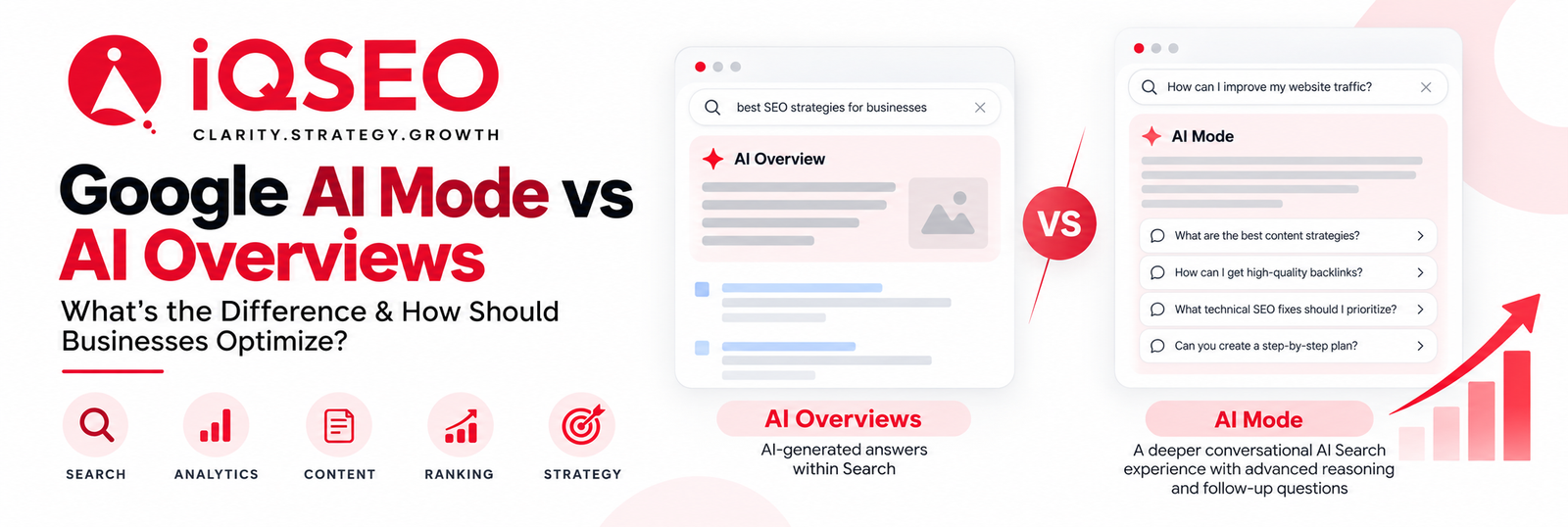
Google Search is changing rapidly. Instead of relying only on traditional blue links, users can now get AI-generated answers, explore topics conversationally, and ask follow-up questions directly within Search.
Two major developments driving this change are Google AI Overviews and Google AI Mode.
Although both use generative AI, they serve different purposes. AI Overviews provide a quick AI-generated snapshot within Google Search, while AI Mode is designed for deeper research, complex questions, comparisons, and follow-up conversations.
For businesses, this creates a new question:
How can you optimize your website to stay visible in Google’s evolving AI-powered search?
The answer isn't to abandon traditional SEO. Instead, businesses need to strengthen their technical SEO, content quality, topical authority, brand credibility, and ability to answer real customer questions.
In this guide, IQSEO explains the difference between Google AI Mode and AI Overviews and how businesses can prepare for the future of AI-powered search.
What Are Google AI Overviews?
Google AI Overviews are AI-generated summaries that appear within Google Search results when Google's systems determine that an AI-generated response can be useful.
Instead of making users visit several websites to understand a topic, Google can provide a summary containing key information and links to relevant sources.
For example, a user searching:
"How much does SEO cost for a small business?"
may see an AI-generated overview explaining the factors that influence SEO pricing, followed by links to websites where the user can learn more.
Google describes AI Overviews as a way to provide a quick snapshot of information while helping users explore supporting content across the web.
Key characteristics of AI Overviews
-
Appear within the normal Google Search experience
-
Provide AI-generated summaries
-
Include links to relevant web content
-
Help users understand complex topics quickly
-
Can bring together information from multiple sources
-
Can lead users into deeper AI Mode conversations
AI Overviews give businesses a new opportunity to reach users beyond traditional organic search results.
What Is Google AI Mode?
Google AI Mode offers a more advanced, conversational search experience built for deeper research and exploration.
AI Mode goes beyond simple AI summaries by allowing users to ask in-depth questions and explore topics through follow-up queries.
For example, a user might ask:
"What are the most cost-effective digital marketing strategies for small businesses in Coimbatore?"
They could then follow up with:
"How should the strategy change if the main goal is to attract local customers?"
AI Mode can maintain the context and help the user explore the topic further.
Google explains that AI Mode can break a complex question into multiple related searches using a process called query fan-out. These searches can cover different subtopics and sources before Google's systems bring the information together into a response.
AI Mode also supports multimodal interactions, including text, voice, images, and uploaded files.
Google AI Mode vs AI Overviews: How Are They Different?
The simplest distinction is:
AI Overviews provide a quick AI-generated summary, while AI Mode is designed for deeper, conversational exploration.
|
Feature |
AI Overviews |
AI Mode |
|
Main purpose |
Quick understanding |
Deep exploration |
|
Search experience |
Traditional Search with AI |
Dedicated conversational AI experience |
|
Best for |
Questions needing a quick summary |
Complex questions and research |
|
Follow-up questions |
Supported |
Core feature |
|
Query complexity |
Moderate to complex |
Highly complex and multi-step |
|
Web links |
Yes |
Yes |
|
Multiple searches |
Can use multiple sources |
Uses query fan-out extensively |
|
User interaction |
More summary-focused |
More conversational |
Google itself describes AI Mode as expanding what AI Overviews can do by offering deeper reasoning, follow-up questions, and broader exploration.
This distinction matters as the way people search for information continues to evolve.
Why AI Search Matters for Businesses
Traditional SEO mainly revolves around ranking for specific search terms.
But AI-powered search changes the way people discover information.
A user might previously search:
Now they may ask:
"Which SEO companies in Coimbatore can help local businesses improve their visibility on Google and AI search?"
The second query is longer, more specific, and closer to a real business decision.
This means businesses should look beyond ranking for individual keywords.
They should build topical authority around the questions their customers actually ask.
A well-optimized website should provide clear answers to questions like:
-
What does the business offer?
-
Who is it for?
-
How does the service work?
-
How much does it cost?
-
What results can customers expect?
-
Why should customers trust the company?
-
How does the company compare with alternatives?
The goal is to become a reliable source of information, not simply another page targeting a keyword.
How Can Businesses Optimize for Google AI Mode and AI Overviews?
The good news is that businesses don't need a completely separate SEO system for Google's AI features.
Google continues to emphasize the importance of foundational SEO and high-quality web content for AI-powered Search experiences.
Here are the most important areas to focus on.
1. Build a Strong Technical SEO Foundation
Before focusing on AI visibility, make sure Google can easily access and understand your website.
Check:
-
Crawling
-
Indexing
-
Mobile usability
-
Page speed
-
HTTPS
-
Canonical tags
-
XML sitemap
-
Robots.txt
-
Internal links
-
JavaScript accessibility
If important pages aren't properly accessible or indexed, AI optimization won't fix the underlying problem.
Traditional SEO continues to be the foundation for visibility in AI search.
2. Create Helpful, People-First Content
Don’t create content solely to target AI-related keywords.
Create content that solves a real problem.
For example, instead of writing:
"AI SEO Services AI SEO Company AI SEO Experts"
create:
"How Can Small Businesses Improve Their Visibility in AI Search?"
The second approach focuses on the user's problem.
Your content should provide clear explanations, useful examples, original insights, and actionable recommendations.
Google's AI search experiences rely on web information, so businesses should continue investing in useful and trustworthy content.
3. Optimize for Conversational Search Intent
AI-powered search makes it easier for users to ask detailed questions.
Your content should therefore address conversational queries.
For example:
Traditional keyword
SEO cost
Conversational search
"How much should a small business spend on SEO every month?"
Another example:
Traditional keyword
Local SEO
Conversational search
"How can a local business get more customers from Google?"
Don't just repeat keywords.
Understand the search intent behind the question and provide a complete answer.
4. Build Topical Authority
One article is rarely enough to establish expertise around a competitive topic.
Suppose your business specializes in SEO.
You could create a content cluster around AI search:
-
What Is AI SEO?
-
Google AI Overviews Explained
-
Google AI Mode vs AI Overviews
-
What Is GEO?
-
What Is AEO?
-
How to Optimize Content for AI Search
-
Entity SEO Explained
-
How AI Search Is Changing SEO
-
How to Track AI Search Visibility
Connect these articles through relevant internal links.
This creates a stronger topical relationship between your pages and gives users multiple ways to explore a subject.
For IQSEO, this is especially relevant because the company already focuses on traditional SEO alongside AI-powered search strategies and GEO.
5. Demonstrate Expertise and Trust
AI search makes brand credibility increasingly important.
Your website should clearly communicate:
-
Who created the content
-
Who operates the business
-
What experience the business has
-
What services it provides
-
What results it has achieved
-
Why customers should trust it
Useful trust signals can include:
-
Author bios
-
Case studies
-
Customer reviews
-
Original research
-
Client results
-
Expert opinions
-
Company information
-
Industry experience
Don't simply tell users that you're an expert.
Show them evidence.
6. Publish Original Information
AI can summarize information that already exists.
Therefore, businesses should create content that adds something new.
Consider publishing:
-
Original research
-
Customer case studies
-
First-hand experiences
-
Industry data
-
Expert analysis
-
Unique frameworks
-
Real examples
-
Before-and-after results
For example:
"What We Learned From Improving AI Search Visibility for Local Businesses"
is potentially more valuable than another generic article explaining what SEO means.
Original experience is one of the strongest ways to differentiate your content.
7. Use Structured Data Correctly
Structured data helps search engines understand the information on a page.
Depending on your content, you may use appropriate schema such as:
-
Organization
-
LocalBusiness
-
Article
-
Person
-
BreadcrumbList
-
Product
However, businesses should avoid the misconception that there is a special "AI Overview schema" or "AI Mode schema."
There isn't a special markup that guarantees visibility in Google's AI experiences.
Structured data should accurately describe the visible content on the page.
The objective should be better understanding, not trying to manipulate AI results.
8. Strengthen Internal Linking
Internal linking is still extremely important.
Connect related pages so users and search engines can easily understand your website's content structure.
For example:
SEO → AI SEO → GEO → Entity SEO → AI Search Optimization
A blog about AI Mode could naturally link to related IQSEO articles about AI Overviews, GEO, and AI SEO.
This helps create a connected knowledge ecosystem instead of isolated blog posts.
9. Keep Your Business Information Consistent
AI-powered search doesn't operate only around your website.
Your business information can appear across different platforms and sources.
Keep important information consistent across:
-
Google Business Profile
-
Business directories
-
Review platforms
-
Social profiles
-
Industry websites
-
Company profiles
Make sure your business name, website, services, location, and other important information are accurate.
For local businesses, this becomes particularly important because customers increasingly use conversational search to discover nearby services.
10. Don't Mass-Produce Generic AI Content
One of the biggest mistakes businesses can make is publishing hundreds of AI-generated articles without adding real value.
AI can help with:
-
Research
-
Content outlines
-
Topic discovery
-
Data analysis
-
Editing
-
Brainstorming
But the final content should still provide human expertise, experience, and original value.
The goal isn't to publish more content.
The goal is to publish better content.
How Can Businesses Measure AI Search Visibility?
Measuring AI visibility is different from tracking traditional keyword rankings.
Businesses should monitor several areas.
Traditional SEO metrics
-
Organic impressions
-
Organic clicks
-
Keyword rankings
-
Organic traffic
-
Landing-page performance
-
Conversions
Business metrics
-
Leads
-
Sales
-
Revenue
-
Conversion rate
-
Cost per acquisition
AI visibility indicators
-
Brand mentions in AI responses
-
Citations from AI search experiences
-
Referral traffic where measurable
-
Visibility for conversational queries
-
Presence across Google AI experiences
The important point is to avoid relying on a single "AI ranking" metric.
AI search is dynamic, and different users can receive different responses.
Common AI SEO Mistakes to Avoid
1. Looking for an AI ranking hack
There is no guaranteed shortcut for appearing in AI Overviews or AI Mode.
2. Keyword stuffing
Repeating a keyword doesn't automatically make content more relevant.
3. Publishing generic AI content
AI-generated content without expertise or originality can add little value.
4. Ignoring technical SEO
AI optimization cannot compensate for serious crawling or indexing problems.
5. Creating thin content
Short answers are useful when they fully answer a question. Thin pages that provide little value are different.
6. Ignoring brand authority
Your website is only one part of your online presence.
Build credibility across your entire digital ecosystem.
Should Businesses Optimize for AI Mode or AI Overviews?
Both.
But businesses shouldn't create two completely separate SEO strategies.
Instead, build a strong overall search strategy based on:
Technical SEO + Helpful Content + Topical Authority + AEO + GEO + Brand Authority
Traditional SEO remains the foundation.
AEO helps structure information around questions and answers.
GEO focuses on visibility within generative search experiences.
Brand authority strengthens trust and recognition.
Together, these create a more future-ready search strategy.
The Future of SEO Is AI-Ready SEO
Google AI Mode and AI Overviews are changing how users discover information, but the fundamental objective of SEO hasn't changed.
Give people useful information and make it easy for search engines to understand.
The difference is that search is becoming more conversational and increasingly capable of synthesizing information from multiple sources.
Businesses should therefore move beyond the question:
"How do I rank for this keyword?"
and start asking:
"How can my business become one of the most useful and trusted sources for the questions my customers are asking?"
That shift is at the heart of modern SEO.
How IQSEO Can Help Your Business
At IQSEO, we combine traditional SEO with AI-powered search strategies to help businesses improve their visibility across Google and emerging AI search experiences.
Our approach can include:
-
Technical SEO
-
Traditional SEO
-
Local SEO
-
AI SEO
-
Generative Engine Optimization
-
Content strategy
-
Entity SEO
-
AI search visibility
IQSEO focuses on helping businesses adapt to how people search today while building a strong foundation for tomorrow's search landscape.
If your business wants to improve its visibility across Google Search and AI-powered search experiences, the right time to build an AI-ready SEO strategy is now.
Talk to IQSEO and build a search strategy designed for the next generation of Google.
Frequently Asked Questions
What is the difference between Google AI Mode and AI Overviews?
AI Overviews provide an AI-generated summary within Google Search, while AI Mode is designed for deeper conversations, complex questions, follow-ups, and exploration.
Is Google AI Mode replacing traditional Search?
No. AI Mode is an additional search experience. Traditional Google Search and organic SEO remain important.
Do businesses need special SEO for AI Mode?
No separate technical SEO system is required. Businesses should continue focusing on strong technical SEO, useful content, crawlability, indexing, internal linking, and authority.
Is there a special schema for Google AI Overviews?
No. Businesses don't need a special AI Overview or AI Mode schema. Use structured data only when it accurately represents the visible content on the page.
Can SEO help a website appear in AI Overviews?
Strong SEO can help Google discover and understand your content, but there is no guarantee that a particular page will appear in an AI-generated response.
What is GEO in SEO?
GEO, or Generative Engine Optimization, focuses on improving a brand's visibility and representation within generative AI and AI-powered search experiences.
How can I prepare my website for AI search?
Start with technical SEO, create helpful, people-first content, answer real customer questions, build topical authority, strengthen your brand credibility, use accurate structured data, and develop a strong internal linking structure.
Final Takeaway
Google AI Mode and AI Overviews are changing how people search, but they don't eliminate SEO. They make strong SEO even more important.
Businesses that invest in technical foundations, helpful content, topical authority, original insights, and brand trust will be better positioned as search becomes increasingly AI-driven.
Don't optimize only for rankings.
Optimize to become the source Google and your customers can trust.
That is the future of SEO.