







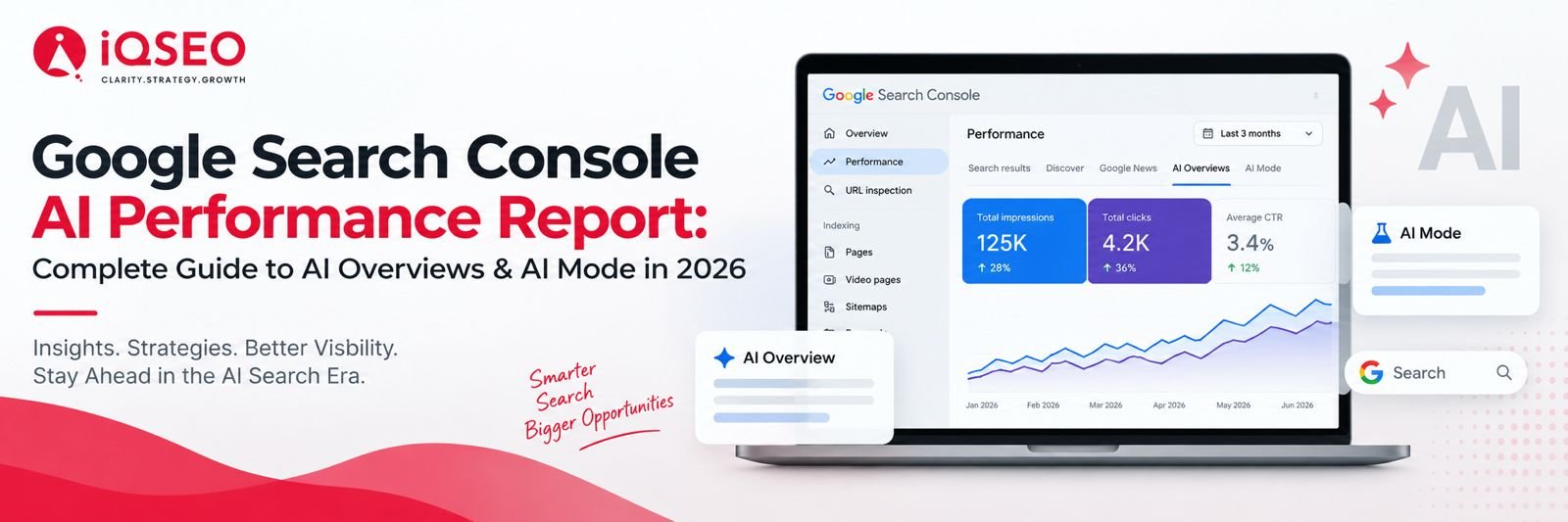
Google Search is changing rapidly. Users are no longer relying only on traditional blue links to find information. With AI Overviews and AI Mode, Google can now generate AI-powered responses that summarize information from multiple sources and help users explore topics through conversational searches.
As AI search continues to evolve, website owners and SEO professionals need to know how to track their website's visibility across Google's AI-powered search experiences.
In 2026, Google Search Console has become even more important for answering that question. Google introduced a dedicated Search Generative AI performance report, providing site owners with a specific view of visibility generated through Google's AI-powered search features.
This guide explains what the Google Search Console AI Performance Report means, how AI Overviews and AI Mode affect SEO, which metrics you should monitor, and how businesses can adapt their SEO strategy for the new search environment.
How Does Google Search Console Measure AI Search Performance?
Google Search Console provides website owners with useful data on how their pages gain visibility and perform across Google's generative AI search experiences.
Google's new reporting provides a dedicated view for impressions generated through generative AI features, including AI Overviews and AI Mode, while this activity also remains part of the broader Search Console Performance data.
This means SEO reporting now goes beyond traditional keyword rankings. Businesses need to monitor not only where their pages rank but also how visible their content is across Google's AI-powered search features.
For SEO teams, this creates another layer of visibility to analyze alongside:
-
Organic clicks
-
Organic impressions
-
Click-through rate (CTR)
-
Average position
-
Search queries
-
Landing pages
-
AI-generated search visibility
What Are Google AI Overviews?
AI Overviews are Google's AI-powered summaries that can appear for relevant searches, giving users a quick overview of the information they need.
Instead of requiring users to open several websites and compare information themselves, Google may provide a summarized answer with links to supporting web pages.
For example, someone searching:
"How much does SEO typically cost for a small business?"
may receive an AI-generated overview explaining the major pricing factors, followed by links to relevant sources.
This changes how websites can receive visibility. A webpage can still be used as a source for an AI Overview even if users don't interact with it in the same way they would with a traditional search result.
Google explains that its generative AI features are built on its existing Search ranking and quality systems. Therefore, traditional SEO fundamentals continue to matter.
What Is Google AI Mode?
AI Mode provides a more conversational and exploratory search experience.
Instead of entering a short keyword and reviewing a standard list of results, users can ask longer and more detailed questions and continue the conversation with follow-up queries.
For example, a user might search:
"What is the best SEO strategy for a local business with a limited budget?"
They could then ask:
"What should I focus on first?"
AI Mode is designed to support this type of deeper exploration.
For businesses, this means search visibility is increasingly connected to topics, context, entities, user intent, and comprehensive content, rather than only individual keywords.
AI Overviews vs AI Mode
Although both are part of Google's generative AI search experience, they serve different purposes.
AI Overviews generally provide an AI-generated summary within the traditional Search experience.
AI Mode provides a more conversational environment where users can ask complex questions, explore topics, and continue searching through follow-up prompts.
For SEO professionals, the important takeaway is that both experiences can create new opportunities for website visibility.
Instead of optimizing a page only for:
you should also consider related questions such as:
-
What does an SEO company do?
-
How much does SEO cost?
-
How long does SEO take?
-
What are the benefits of SEO?
-
How does local SEO work?
-
How can a business increase Google visibility?
This approach creates deeper topical coverage and helps search engines understand the overall subject of your website.
How Does AI Search Affect Traditional SEO?
One of the biggest misconceptions about AI search is that traditional SEO is becoming irrelevant.
That is not the case.
Google's own guidance states that SEO best practices remain relevant for generative AI search because AI features are rooted in Google's existing Search ranking and quality systems.
This means fundamentals such as the following remain important:
-
Helpful, original content
-
Strong technical SEO
-
Crawlable website architecture
-
Clear page structure
-
Relevant internal links
-
Descriptive titles and headings
-
Mobile-friendly design
-
Good page experience
-
Author expertise and credibility
-
Reliable information
-
Structured data where appropriate
The key difference is that SEO now has to focus on a wider range of search experiences rather than relying solely on traditional rankings.
Important Metrics to Monitor in Search Console
When analyzing AI search performance, don't focus on one metric alone.
1. Impressions
Impressions indicate how frequently your pages are shown or surfaced within Google's search ecosystem.
Increasing impressions can indicate growing visibility, even when clicks do not increase at the same rate.
2. Clicks
Clicks remain one of the most important indicators of traffic generated from Google Search.
Compare click trends with impressions to determine whether increased visibility is translating into website visits.
3. Click-Through Rate
CTR helps you understand how effectively your search visibility attracts users.
A page receiving many impressions but relatively few clicks may need improvements to its title, description, search intent alignment, or overall content positioning.
4. Average Position
Average position continues to provide useful context for traditional Search performance.
However, AI-powered search experiences make it important to avoid judging SEO success solely through one ranking number.
5. Queries
Search queries reveal what users are actually looking for.
Look beyond short keywords and identify:
-
Question-based searches
-
Long-tail queries
-
Comparison searches
-
Problem-solving searches
-
Commercial-intent searches
-
Informational searches
These insights can help you create content that addresses your customers' needs at every stage of their journey.
6. Pages
Analyze which pages receive the strongest visibility.
Your highest-performing pages can reveal the topics, formats, and content structures that Google considers useful for your audience.
How to Optimize Your Website for AI Overviews and AI Mode
There is no guaranteed method for making a page appear in an AI Overview or AI Mode response.
However, you can improve your overall search visibility by following strong SEO principles.
Create Helpful, Original Content
Avoid producing generic articles that simply repeat information already available online.
Add original insights, examples, data, experiences, and practical recommendations.
Content should solve the user's problem rather than exist only to target keywords.
Answer Questions Clearly
AI-powered search often involves conversational queries.
Structure your content around real questions your audience asks.
Use descriptive H2 and H3 headings and provide direct answers before expanding into supporting details.
Build Topical Authority
Instead of publishing isolated articles, create related content around important subjects.
For example, an SEO agency could build a topic cluster around:
SEO
-
Technical SEO
-
Local SEO
-
E-commerce SEO
-
International SEO
-
Keyword research
-
Link building
-
SEO audits
-
AI SEO
-
Google Search Console
-
Content optimization
This helps establish deeper topical relevance.
Strengthen Internal Linking
Internal links help users and search engines discover related pages.
When publishing an article about AI SEO, link naturally to relevant service pages, related blog posts, and supporting resources.
For IQSEO, this can also help connect AI-search content with relevant SEO services.
Use Structured Data Correctly
Structured data can help search engines understand important information about a page.
Depending on the content, relevant structured data may include Article, Organization, Breadcrumb, and other supported schema types.
However, structured data should accurately represent the visible content on the page. It should not be treated as a shortcut for obtaining AI visibility.
Demonstrate Experience and Trust
Google emphasizes high-quality content and reliable information.
Clearly communicate who created the content, demonstrate relevant expertise, and support important claims with trustworthy information.
Avoid creating large amounts of low-value AI-generated content simply to increase the number of pages on your website. Google warns that generating many pages with AI without adding value can fall under its spam policies.
How SEO Reporting Should Change in 2026
Traditional SEO reports often focus on:
Rankings → Traffic → Leads
In the AI search era, businesses should expand this model:
Search visibility → AI visibility → Traffic → Engagement → Leads → Revenue
This doesn't mean abandoning rankings.
Instead, AI visibility should become another performance layer within your SEO reporting strategy.
For example, a monthly report could include:
-
Organic clicks
-
Organic impressions
-
CTR
-
Keyword rankings
-
Top-performing pages
-
Search queries
-
AI search visibility
-
Content performance
-
Organic leads
-
Conversions
This gives businesses a much clearer picture of how their website performs across modern search experiences.
What Does This Mean for Businesses?
The growth of AI-powered search means businesses need to think beyond individual keywords.
A website that provides clear, trustworthy, and comprehensive answers has more opportunities to become visible across different search experiences.
For local businesses, this is especially important.
Instead of creating content only around a location keyword, develop useful resources that answer customer questions about your products, services, pricing, processes, and local market.
For example, an SEO company in Coimbatore could create resources covering local SEO, Google Business Profile optimization, technical SEO, content marketing, AI SEO, and search analytics.
IQSEO already focuses on both traditional SEO and AI-driven search optimization, helping businesses improve visibility across Google and emerging AI search platforms.
Final Thoughts
Google Search is becoming more conversational, contextual, and AI-driven.
The introduction of dedicated generative AI performance reporting in Google Search Console gives SEO professionals another way to understand how their websites perform within this changing search environment.
However, the fundamentals remain the same: create useful content, understand search intent, maintain a technically healthy website, demonstrate expertise, and build genuine authority.
In 2026, successful SEO is no longer just about achieving position one for a keyword.
It is about making your website visible, useful, and trustworthy across the entire search journey.
If your business wants to prepare for AI-powered search while continuing to grow through traditional Google SEO, IQSEO can help build a strategy that combines technical SEO, content optimization, and AI search visibility.
Ready to improve your search visibility in 2026? Contact IQSEO and build an SEO strategy designed for the next generation of Google Search.