






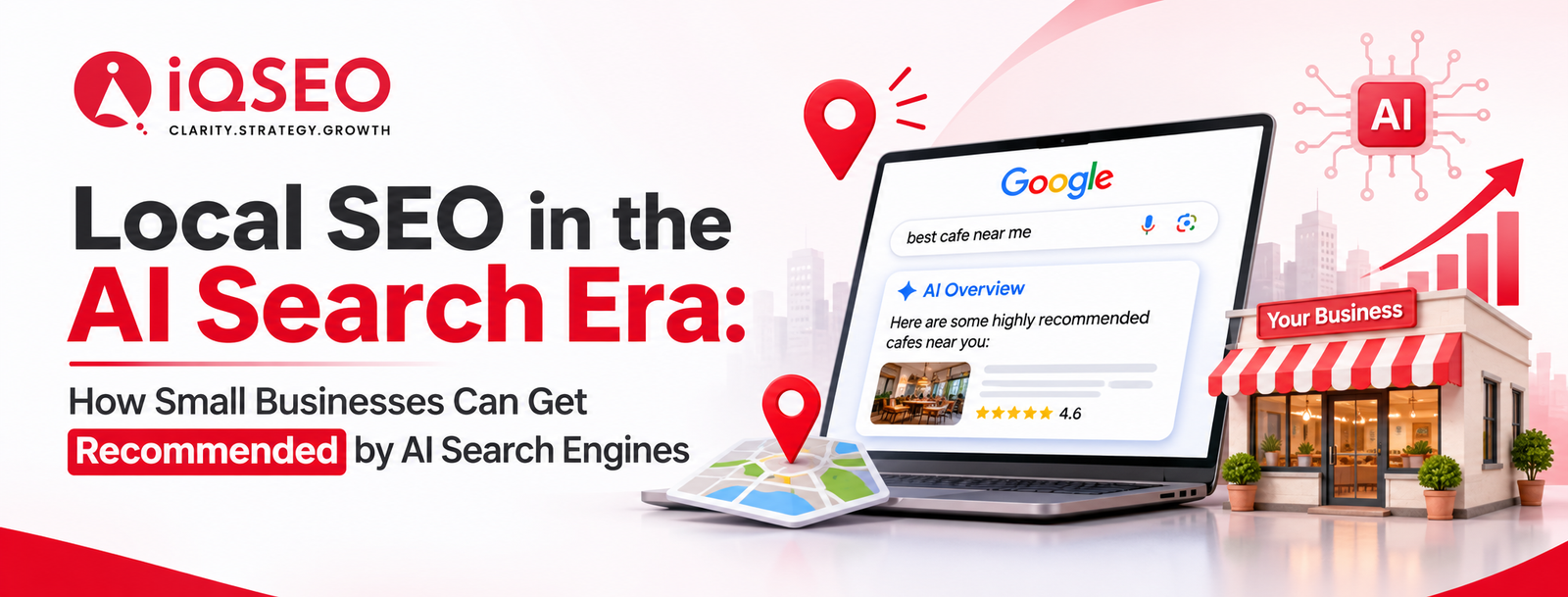
The way customers find and connect with nearby businesses is evolving quickly. In the past, customers mainly used Google Search and Google Maps to find nearby services, compare businesses, and make purchasing decisions. Today, AI-powered search platforms are introducing new ways for people to discover brands and get recommendations.
Instead of searching for a simple keyword such as "best digital marketing company near me", users can now ask detailed questions like "Which digital marketing agency is suitable for a small business in Coimbatore?" AI-powered platforms can understand these questions, analyse relevant information, and provide recommendations based on the user's requirements.
This change creates new opportunities and challenges for small businesses. Having a website and a Google Business Profile is still important, but businesses must also establish a reliable online presence, publish useful information, and demonstrate their expertise across different platforms.
This is where Local SEO in the AI Search Era becomes important. By combining traditional Local SEO practices with strategies for AI search visibility, small businesses can improve their chances of being discovered by potential customers.
1. How AI-Powered Search Is Transforming Local SEO
Traditional search engines display websites based on their relevance to a user's search query. Customers generally visit different websites, compare services, and choose a business that meets their expectations.
AI-powered search platforms provide a different experience. They can understand conversational questions, summarise information from multiple sources, and present relevant suggestions to users.
For example, someone looking for an interior designer might ask an AI platform to recommend experienced interior designers in their city. The platform may consider information available from business websites, customer reviews, online publications and other sources before generating a response.
For small businesses, this means online visibility is no longer limited to appearing in traditional search results. Businesses should make their services, locations, experience, and contact information easy to discover and understand.
Start by identifying the questions your potential customers ask and ensure your website provides clear, accurate answers.
2. Optimise Your Google Business Profile
Google Business Profile remains an important part of Local SEO because it helps customers discover businesses through Google Search and Maps.
A complete and regularly updated profile provides useful information about your business, including its services, location, contact details, and operating hours.
To strengthen their online presence, small businesses should consider these important aspects.
-
Business Information: Maintain an accurate business name, address, phone number, and website URL.
-
Business Categories: Select the primary and secondary categories that accurately describe your services.
-
Business Description: Explain what your business offers, its experience, and the locations it serves.
-
Services: Add relevant services with clear descriptions.
-
Photos and Videos: Upload genuine images of your workplace, team, products, and completed projects.
-
Opening Hours: Keep regular and holiday operating hours updated.
-
Customer Reviews: Encourage genuine customers to share their experiences and respond to their feedback.
For example, a digital marketing agency in Coimbatore should clearly explain its SEO, website development, and digital marketing services rather than using a generic business description.
A well-maintained profile improves the information available to customers and supports your overall local search presence. However, simply completing a profile does not guarantee recommendations from AI platforms.
3. Maintain Consistent Business Information Across Online Platforms
Consistency is essential when establishing a recognisable business identity online.
Search engines and AI-powered platforms can discover business information from different sources, including websites, business directories, social media accounts, and review platforms.
If your business name, address, or phone number differs across these sources, customers may find it difficult to identify the correct business information.
This is why businesses should maintain consistent NAP details (Name, Address, and Phone Number).
Consider maintaining your business information across:
-
Google Business Profile
-
Bing Places
-
Apple Business Connect
-
Relevant local business directories
-
Industry-specific directories
-
Facebook and LinkedIn business pages
For businesses operating in multiple locations, maintain accurate information for each genuine business location.
Avoid creating unnecessary listings or submitting your business to irrelevant directories. Instead, prioritise trusted platforms that are relevant to your industry and target audience.
Consistent business information helps establish a clearer online identity and makes it easier for potential customers to contact you.
4. Create Location-Specific Content for Your Website
Location-based content helps businesses connect with customers searching for services in particular areas.
For example, someone looking for a service may search for:
-
SEO Company in Coimbatore
-
Website Development Company in Madurai
-
Interior Designers in Theni
-
Wedding Photographers in Chennai
Creating dedicated location landing pages can help your website address these searches more effectively.
However, simply changing the city name across multiple pages is not a useful long-term strategy. Every location page should provide relevant information that addresses the needs of customers in that area.
Include the following elements:
-
Services available in the particular location.
-
Customer requirements and common local challenges.
-
Relevant projects and case studies.
-
Customer experiences and testimonials.
-
Frequently asked questions.
-
Accurate contact information and enquiry options.
For example, a digital marketing agency targeting Coimbatore businesses can explain how Local SEO helps restaurants, educational institutions, healthcare providers and other service-based businesses attract nearby customers.
Adding genuine experience and useful local information makes your content more valuable than publishing multiple pages with repetitive descriptions.
5. Build Customer Reviews and Online Reputation
Customer reviews play an important role in helping people evaluate local businesses. Before contacting a service provider, many customers check ratings, read previous experiences and compare feedback from different platforms.
Reviews also provide useful context about the services a business offers and the quality of its customer experience.
For example, a review stating that a company helped improve website visibility through SEO provides more information than a simple comment saying "Good service".
Small businesses can strengthen their online reputation through the following practices:
-
Request honest feedback from genuine customers.
-
Make the review process simple and convenient.
-
Respond professionally to positive and negative reviews.
-
Address customer complaints and concerns.
-
Monitor reviews across relevant platforms.
-
Avoid purchasing fake reviews or offering incentives for positive ratings.
Businesses should focus on delivering a positive customer experience rather than collecting ratings alone.
Genuine reviews can help potential customers make informed decisions and contribute to a stronger online reputation. However, positive reviews do not guarantee that an AI search platform will recommend your business.
6. Implement Structured Data for Better Business Understanding
Structured data helps search engines interpret important information about your website and business.
For local businesses, relevant Schema.org markup can describe details such as:
-
Business name and category
-
Address and contact information
-
Website URL
-
Opening hours
-
Geographic location
-
Services offered
The LocalBusiness schema is useful for eligible businesses that want to communicate their business information in a structured format.
For example, a restaurant can use structured data to describe its address, opening hours and contact details. Similarly, a service-based company can implement relevant business and service-related markup.
When implementing structured data, ensure that the information matches the actual content displayed on your website.
It is important to understand that schema markup is not a shortcut to AI search recommendations. It supports search engines in understanding your business information and should be part of a broader technical SEO strategy.
7. Publish Helpful FAQs and Conversational Content
Customers increasingly use detailed questions when searching for products and services. Instead of entering short keywords, they may explain their requirements and expect direct answers.
This makes question-based content an important part of a modern Local SEO strategy.
For example, a customer looking for a website development company may ask:
-
How much does website development cost in Coimbatore?
-
How long does it take to develop a business website?
-
What services should a digital marketing agency provide?
-
How can a small business improve Google Maps visibility?
-
Why is Local SEO important for a physical business?
Your website should provide clear and useful answers to these questions.
Follow these content practices:
-
Use questions based on actual customer concerns.
-
Provide direct answers before explaining the topic in detail.
-
Include relevant examples and local context.
-
Avoid unnecessary keyword repetition.
-
Support your information with practical experience.
-
Update outdated information regularly.
You can also publish informative blogs, service guides, and comparison articles that address different stages of the customer's decision-making process.
The objective should always be to answer real questions rather than creating content solely to attract search engine traffic.
8. Build Relevant Backlinks and Local Brand Mentions
Your website is not the only place where your business reputation is established. Mentions from trusted websites, local publications, and relevant industry platforms can help increase brand awareness and strengthen your online presence.
Small businesses can explore several opportunities to build relevant online mentions:
-
Collaborate with other local businesses.
-
Participate in community events.
-
Contribute articles to relevant industry websites.
-
Get featured in local news publications.
-
Join recognised business associations.
-
Share genuine customer success stories.
-
Build relationships with relevant organisations.
For example, a digital marketing agency in Coimbatore could publish an informative article on a local business website explaining how small businesses can improve their online visibility.
Focus on earning relevant and trustworthy mentions instead of collecting large numbers of low-quality backlinks.
A strong digital reputation takes time to develop. Prioritise genuine relationships, useful contributions and consistent brand information across the web.
9. Improve Website Technical SEO and Accessibility
High-quality content alone cannot deliver strong search visibility if search engines cannot properly access or understand your website.
Technical SEO helps ensure that important website pages can be discovered, crawled, and indexed.
Small businesses should regularly review these essential elements:
Crawlability and Indexing: Ensure that important pages are accessible to search engine crawlers and are not accidentally blocked through robots.txt or noindex directives.
XML Sitemap: Maintain an updated sitemap containing important and indexable website URLs.
Mobile-Friendly Design: Make sure your website works smoothly across smartphones, tablets, and desktop devices.
Page Speed: Optimise images, reduce unnecessary scripts and improve server response times to provide a better browsing experience.
HTTPS Security: Use a secure HTTPS connection to protect website visitors.
Internal Linking: Connect relevant service pages, location pages and blog articles to help users and search engines discover related information.
Also, ensure that important website content is available in readable text rather than relying entirely on images or inaccessible elements.
These technical improvements support traditional search visibility and help maintain a website that can be discovered through AI-powered search experiences.
10. Monitor Your Visibility Across AI Search Platforms
Traditional SEO reporting generally focuses on keyword rankings, organic clicks, impressions, and website traffic.
With AI-powered search becoming more common, businesses should also understand how their brand appears in conversational search experiences.
You can periodically test questions related to your industry and location across platforms such as:
-
Google AI Overviews and AI Mode
-
Microsoft Copilot
For example, try searching:
-
Which is the best SEO company in Coimbatore?
-
Recommend a reliable website development company in Coimbatore.
-
Which digital marketing agencies offer Local SEO services?
-
What are the best SEO solutions for small businesses?
Observe whether your business appears, which competitors are mentioned and whether the information presented about your company is accurate.
Alongside these checks, use SEO tools to monitor your website performance.
Google Search Console: Track organic clicks, impressions, search queries and indexing performance.
Google Analytics 4: Understand website traffic, user engagement and conversions.
Google Business Profile: Monitor customer interactions and available business performance data.
Bing Webmaster Tools: Review search performance and website indexing.
Remember that AI-generated recommendations can change depending on the question, location, platform and available information. A single response should not be treated as proof of ranking or guaranteed visibility.
11. Avoid Common Local SEO Mistakes
While improving local search visibility, businesses should avoid practices that can weaken their online presence.
Some common mistakes include:
-
Keyword Stuffing: Repeating location names and service keywords unnecessarily can reduce content quality.
-
Duplicate Location Pages: Publishing similar pages with only city names changed provides little additional value.
-
Ignoring Customer Reviews: Failing to respond to feedback can create a poor impression.
-
Inconsistent Business Details: Different contact information across platforms can confuse customers.
-
Low-Quality AI Content: Publishing large volumes of generic, unreviewed content does not establish expertise.
-
Neglecting Technical SEO: Broken links, indexing problems and poor mobile usability can affect website performance.
-
Expecting Guaranteed AI Recommendations: No SEO strategy can promise that an AI platform will recommend a particular business.
Instead, focus on genuine business credibility, useful content, accurate information and a positive customer experience.
12. The Future of Local SEO for Small Businesses
Local SEO is expanding beyond traditional keyword rankings and Google Maps visibility. As AI-powered search experiences continue to evolve, customers may increasingly depend on conversational search to discover services, compare providers and make purchasing decisions.
This does not mean traditional SEO is becoming irrelevant. Businesses should strengthen their existing SEO foundations while adapting their content and online presence to changing customer search behaviour.
Small businesses that invest in accurate business information, helpful website content, genuine customer reviews, relevant brand mentions and technical SEO can establish a stronger foundation for future search visibility.
The goal is not simply to appear in search results but to become a credible and recognisable business within your industry and service area.
Conclusion
The AI Search Era is creating new opportunities for small businesses to connect with potential customers and improve their online visibility.
Getting recommended by AI search engines is not about using secret optimisation techniques. It requires a trustworthy online presence, accurate business information, helpful content and a strong reputation across relevant platforms.
Traditional Local SEO remains the foundation, while Answer Engine Optimisation (AEO) and Generative Engine Optimisation (GEO) provide additional approaches to improving visibility across AI-powered search experiences.
For small businesses, the right time to strengthen their digital presence is now. Focus on understanding customer requirements, sharing genuine expertise and making your business easy to discover across different search platforms.
How IQSEO Helps Businesses Improve Their Search Visibility
At IQSEO, we understand that online visibility involves more than ranking for a few keywords. Businesses need a well-planned SEO strategy that connects them with relevant audiences across traditional and AI-powered search platforms.
Our approach combines Local SEO, technical SEO, Answer Engine Optimisation (AEO) and Generative Engine Optimisation (GEO) to help businesses strengthen their digital presence.
From Google Business Profile optimisation and location-based content to technical improvements and AI search visibility, we focus on building a sustainable foundation for online growth.
Whether you are a startup, small business or established company, the right SEO strategy can help you reach potential customers and create meaningful business opportunities.
Want to improve your business visibility across Google and AI-powered search platforms? Visit IQSEO to explore SEO solutions for your business.
Frequently Asked Questions
1. What is Local SEO in the AI Search Era?
Local SEO in the AI Search Era involves improving a business's online presence so that potential customers can discover it through traditional local search results, Google Maps and AI-powered search experiences.
2. How can small businesses get recommended by AI search engines?
Small businesses can improve their chances by maintaining accurate business profiles, publishing helpful website content, collecting genuine customer reviews, building relevant online mentions and maintaining a technically accessible website.
3. Does Google Business Profile help with AI search visibility?
Google Business Profile provides important information about a business, including its location, services, contact details, operating hours and customer reviews. Maintaining an accurate profile supports local discovery and helps customers evaluate the business.
4. Is traditional Local SEO still important for AI search?
Yes. Traditional Local SEO practices such as website optimisation, business profile management, customer reviews, local authority building and technical SEO remain important foundations for online visibility.
5. What is the difference between Local SEO, AEO and GEO?
Local SEO focuses on improving visibility for location-based searches. AEO focuses on making content useful for direct answers, while GEO focuses on improving the chances of brand information being referenced in generative AI responses.
6. Can a small business appear in ChatGPT recommendations without a high-authority website?
Yes, it is possible. A small business can establish visibility through relevant service information, genuine reviews, consistent business details and trusted third-party mentions. However, AI recommendations are not guaranteed.