







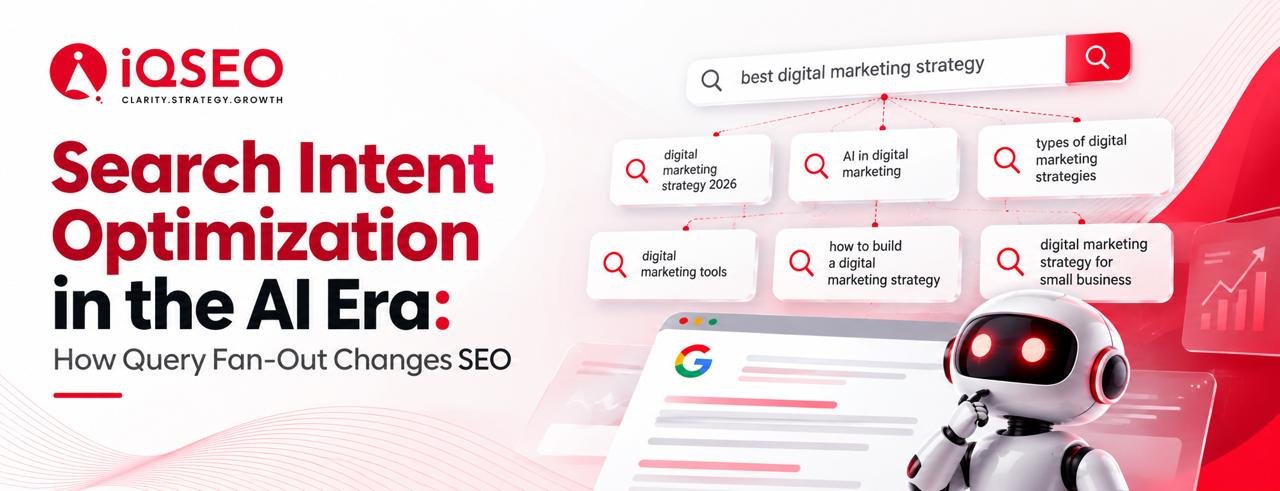
Search has always focused on identifying user intent, but the way search engines understand and interpret those intentions is evolving rapidly.
A few years ago, someone looking for an SEO service might type “best SEO company in Coimbatore” into Google, browse a list of websites, and compare a few agencies before making a decision. Today, the same person might ask an AI-powered search tool, “Which SEO company can help my business improve Google rankings, generate qualified leads, and increase visibility in AI search?”
Although both searches have a similar goal, the second question contains several different needs. The user wants to understand service quality, compare providers, evaluate business outcomes, and explore newer search optimization methods.
AI-powered search experiences can investigate these related needs before generating a response. This process is commonly known as query fan-out.
For SEO professionals, this marks a significant change in how search optimization strategies need to evolve. Optimizing a page is no longer just about targeting a primary keyword and placing it in the right locations. It also means understanding the broader questions behind that keyword and providing useful, reliable answers.
So, how does query fan-out work, and what does it mean for search intent optimization? Let's explore its impact on modern SEO and the practical steps businesses can take to adapt.
What Is Search Intent Optimization?
Search intent optimization means creating website content that aligns with what users are looking for when they enter a search query.
Someone searching for “what is technical SEO” is probably looking for an explanation. Someone searching for “technical SEO audit checklist” wants actionable steps. A person searching for “technical SEO agency” may be evaluating service providers.
Although these searches relate to the same subject, they represent different needs.
Search intent can be divided into four primary types:
Informational intent: Users want to learn about a topic, understand a concept, or find answers to their questions. For example, “What does search intent optimization mean?”
Navigational intent: Users want to find a specific website, brand, or online destination. For example, “IQSEO website.”
Commercial investigation intent: Users compare options before making a decision. For example, “Best AI SEO tools for digital marketing agencies.”
Transactional intent: Users are ready to take action, such as purchasing a product or hiring a service. For example, “Hire an SEO consultant.”
Understanding these differences helps businesses create content that meets users’ expectations and answers their specific needs.
However, real searches are not always so straightforward. A single query can contain multiple needs, particularly when users are researching a complex subject or preparing to make an important business decision.
This is where AI-driven search introduces a new dimension to search intent optimization.
What Is Query Fan-Out in AI Search?
Query fan-out is a process in which an AI-powered search system generates multiple related queries from an original question to gather additional information.
Instead of relying only on the exact words entered by the user, the system can explore related topics, alternative interpretations, and follow-up questions. It then uses the retrieved information to help construct a response.
For example, consider the query:
“How can a small business improve its online visibility?”
To provide a thorough answer, an AI-powered search system may also examine connected topics, including:
-
SEO strategies suitable for small businesses
-
Local SEO and Google Business Profile optimization
-
Content marketing for organic traffic growth
-
Website performance and technical SEO
-
Brand visibility in AI-generated answers
-
Methods for measuring SEO performance
These are illustrative examples rather than a guarantee of the exact searches a particular AI system will execute.
The important point is that the original query acts as a starting point. The system may analyze multiple related factors before generating a comprehensive response.
For website owners, this creates an opportunity to publish content that answers the main question while addressing the most relevant supporting questions.
Google has documented the use of query fan-out in its AI search experiences, including AI Overviews and AI Mode. However, the specific queries generated and the sources selected can vary depending on the question and search experience.
How Query Fan-Out Changes Traditional SEO
Conventional SEO typically starts with keyword analysis, identifying user search intent, and optimizing individual web pages. These practices remain important, but AI-assisted search introduces additional considerations.
1. From Individual Keywords to Connected Questions
A traditional content plan might assign one article to “AI SEO” and another to “AI SEO benefits.” This approach can still work when each article serves a distinct purpose.
However, using keywords in the right places remains essential for effective SEO. Using primary keywords, relevant headings, and natural keyword variations helps search engines understand what a page is about.
A strong article should answer the central question and cover the closely related topics needed to understand it properly.
The objective is not to overload a single webpage with every relevant keyword. It is to create a coherent resource that meets the user's information needs.
2. From Keyword Matching to Contextual Relevance
A page can contain a target keyword several times without genuinely answering the question behind it.
For example, an article targeting “local SEO services” might repeat the phrase throughout the content but provide little information about Google Business Profile optimization, local landing pages, customer reviews, or performance measurement.
Such a page may be keyword-focused without being particularly useful.
In an AI search environment, context becomes especially important. Content should explain concepts clearly, establish relationships between them, and provide enough detail to support the reader's next question.
However, this does not imply that keyword placement has lost its importance. Primary keywords, descriptive headings, and natural variations still help communicate the page's subject. The difference is that they should support a useful explanation rather than become the main objective.
3. From Isolated Pages to Connected Content Ecosystems
Query fan-out does not make individual landing pages or topic clusters obsolete.
A service page, a detailed blog article, and a practical checklist can each serve different search intents. Internal links connect related pages and guide users from one resource to another naturally, from learning about a problem to exploring a solution.
For instance, a blog post on search intent optimization can include internal links to related guides covering keyword research, technical SEO, and other relevant SEO topics.
Each page should have a distinct purpose while contributing to the website's overall topical depth.
A well-organized content ecosystem also helps businesses avoid publishing multiple pages that target nearly identical queries without providing meaningfully different information.
4. From Traffic Alone to Visibility and Business Outcomes
An increase in organic impressions does not always translate into more website visits or leads. AI-generated answers may satisfy some users without requiring them to click through to a website.
That makes it important to assess performance beyond a single traffic metric.
SEO teams should continue monitoring organic clicks, impressions, click-through rate, conversions, and relevant keyword rankings. They can also track AI referral traffic where available and document whether their brand appears in relevant AI-generated answers.
The objective is not simply to appear in more places. It is to reach the right audience and help those users make informed decisions.
How to Optimize Content for Search Intent and Query Fan-Out
The practical approach is to combine traditional SEO fundamentals with a deeper understanding of how people explore a topic.
Step 1: Identify the Primary Search Intent
Begin by understanding why someone would search for your target keyword.
Review search results, competing pages, related questions, and the type of content that currently satisfies the query.
If the keyword is “search intent optimization,” users are likely looking for an explanation, practical methods, and examples. A product page or a short promotional landing page may not meet that need.
Define the primary intent before planning the article. This gives the content a clear direction and prevents unrelated sections from diluting its purpose.
Step 2: Map Related Questions and Follow-Up Queries
Once the primary intent is clear, identify the questions that naturally follow from it.
For the topic of search intent optimization in the AI era, these could include:
-
What is query fan-out?
-
How does query fan-out work?
-
How does AI search interpret search intent?
-
How can SEO professionals identify related queries?
-
How should content be structured for AI search?
-
How can businesses measure AI search visibility?
These questions provide a useful content outline. They also help identify gaps in existing articles and opportunities to explain the subject more thoroughly.
Use keyword research tools, Google Search Console, search suggestions, customer conversations, and relevant sales enquiries to validate which questions matter to your audience.
Do not assume that every possible follow-up question deserves a separate heading or article. Prioritize questions that are relevant to the main topic and useful to the intended reader.
Step 3: Group Queries by Intent and Relationship
Not every related query belongs on the same page.
Suppose your keyword research identifies the following searches:
|
Search query |
Likely intent |
Recommended content |
|
What is query fan-out? |
Informational |
Explain the concept in the main article |
|
How does query fan-out affect SEO? |
Informational |
Include a dedicated section |
|
Query fan-out content checklist |
Practical |
Include a checklist or create a supporting resource |
|
AI SEO agency pricing |
Commercial |
Address on a relevant service or pricing page |
|
Hire an AI SEO agency |
Transactional |
Optimize a dedicated service landing page |
This distinction matters because query fan-out should not be interpreted as a reason to combine every related keyword into one oversized article.
A page should cover related questions when doing so improves the reader's understanding. When a query introduces a substantially different need, a separate page may be more appropriate.
Step 4: Build the Article Around Clear Answers
Readers should not have to work through several paragraphs of generic introductions to find a basic answer.
Use descriptive H2 and H3 headings, direct explanations, relevant examples, and short lists where they make information easier to understand.
For example, a section titled “How Does Query Fan-Out Affect SEO?” should explain the effect directly before discussing the wider implications.
This structure helps users navigate the page and makes its information easier for search systems to interpret.
However, there is no guaranteed heading format or word count that secures AI citations. Structure supports clarity; it does not replace accuracy, relevance, or content quality.
Step 5: Add Original Insights and Practical Examples
One of the biggest weaknesses of AI-era content is that many articles repeat the same definitions and recommendations.
To make a page more useful, add something that demonstrates genuine understanding of the topic. This could be an example from a content audit, an anonymized client scenario, a documented workflow, or an explanation of why a particular SEO decision makes sense.
For example, an SEO team could compare a page that targets one keyword narrowly with a revised page that addresses the primary question, relevant supporting questions, and appropriate next steps.
If you include performance results, use verified data and explain the measurement period and context. Avoid inventing case studies or claiming that a particular content change guarantees AI visibility.
Original insights, first-hand experience, and accurate examples can help differentiate a website from competing pages that cover the same basic information.
Step 6: Strengthen Internal Linking
Internal links help users discover related information and give search engines additional context about the relationships between pages.
When publishing an article on query fan-out, consider linking to relevant resources on AI SEO, keyword research, technical SEO, and search optimization services where those pages genuinely help the reader.
Use descriptive anchor text that explains what the destination page covers.
For example, a sentence discussing AI-driven search visibility could link naturally to a detailed guide on AI SEO.
Avoid adding links simply to increase their number. Each link should support the user's journey or provide useful context.
Step 7: Maintain Technical SEO Fundamentals
Content cannot perform well in search if search engines cannot access or index the page appropriately.
Check that the article returns the correct HTTP status, is not accidentally blocked from crawling or indexing, has an appropriate canonical URL, and is included in the XML sitemap if intended for indexing.
Use descriptive page titles, a relevant meta description, and meaningful image alt text. Implement structured data only when it accurately represents the visible content.
Technical accessibility remains an important part of SEO, even as search experiences become more AI-driven.
At the same time, there is no special schema markup or technical shortcut that guarantees inclusion in AI-generated answers. A technically sound page still needs relevant, useful content to compete effectively.
A Practical Example: Applying Query Fan-Out to an SEO Article
Imagine an SEO agency wants to publish an article targeting “SEO for small businesses.”
A narrow approach might explain what SEO means, list a few benefits, and end with a sales pitch.
A more useful approach starts by considering what a small-business owner needs to know before choosing an SEO strategy.
The article could explain the basics of SEO, local search visibility, keyword selection, website optimization, content planning, link building, and performance measurement. It could also explain when a business might need professional support and which results are realistic to expect.
The content would then connect these topics in a logical order, using relevant examples and links to more detailed resources where needed.
This approach addresses several related information needs without turning the page into a collection of unrelated keywords.
For IQSEO, the same principle can be applied to content about AI SEO, local SEO, eCommerce SEO, and technical SEO. Each article should satisfy its primary intent while providing the supporting context readers need to make progress.
The result is a more useful content strategy built around real user needs rather than a list of isolated keywords.
How to Measure Search Intent Optimization in the AI Era
A content strategy should be evaluated using observable results rather than assumptions about how an AI model retrieves information.
Start with Google Search Console to review the queries generating impressions and clicks for the page. Look for relevant queries that the article already appears for, questions with impressions but weak click-through rates, and related topics that may need better coverage.
Use Google Analytics 4 to assess organic sessions, engagement and meaningful conversions. If the article is intended to attract potential clients, measure relevant actions such as service-page visits, enquiry submissions or qualified leads where tracking is available.
For AI search visibility, periodically test a consistent set of relevant prompts across the platforms that matter to your audience. Record whether your brand or article appears, whether the reference is accurate and which competing sources are cited.
Treat these checks as directional observations because results can vary by prompt, location, time and platform.
A useful review process asks three questions:
Is the content reaching people with the intended search intent? Review the queries generating impressions and visits to determine whether they align with the article's purpose.
Does the content help people find the information they need? Assess engagement, navigation patterns, feedback, and relevant conversions where data is available.
Is that visibility contributing to meaningful business outcomes? Monitor qualified leads, enquiry submissions, and other relevant conversion actions rather than relying entirely on rankings or impressions.
These questions keep the SEO strategy focused on performance rather than chasing AI mentions for their own sake.
Common Mistakes to Avoid When Optimizing for Query Fan-Out
Creating a Separate Page for Every Related Query
Similar searches do not always require separate URLs. Creating large numbers of near-identical pages can lead to duplication, overlapping targeting, and a poor user experience.
Combine closely related questions when they serve the same intent, and create separate resources when there is a clear reason to do so.
Adding Keywords Without Adding Value
Mentioning related phrases does not make content comprehensive if the explanations remain shallow.
Each section should answer a genuine question, explain a relevant concept or help the reader take a useful next step.
Treating Every AI Search Platform as Identical
Different platforms and search experiences may retrieve, present and cite information differently. Avoid assuming that visibility in one platform guarantees visibility in another.
Focus on strong content fundamentals and evaluate performance on the platforms relevant to your audience.
Ignoring Traditional SEO
Query fan-out does not eliminate the importance of crawlability, indexability, useful content, relevant links and a strong website structure.
These fundamentals remain essential to building a sustainable search presence.
Measuring Visibility Without Measuring Outcomes
Brand mentions and impressions can be useful indicators, but they should be considered alongside qualified traffic, enquiries and conversions.
A business should understand whether its SEO strategy is attracting the right audience and supporting its wider objectives.
The strongest approach is not to publish the longest article or anticipate every conceivable query. It is to understand the reader's needs and create a resource that answers those needs accurately and efficiently.
The Future of Search Intent Optimization
AI search is changing how information is discovered and assembled, but the underlying objective of SEO remains familiar: connect people with useful information that satisfies their needs.
Query fan-out makes it more important to understand the relationships between a main query and its supporting questions. It also encourages SEO professionals to think beyond isolated keywords and consider how a complete content experience helps users learn, compare and decide.
For businesses, the opportunity lies in building content that combines clear intent alignment, relevant topic coverage, original expertise, strong internal linking and reliable technical foundations.
For SEO agencies, this means developing content strategies that connect keyword research with customer needs, content planning, technical optimization and performance measurement.
At IQSEO, search intent optimization can be approached as part of a broader SEO and AI visibility strategy, helping businesses build a useful presence across traditional search and emerging AI-driven discovery experiences.
The takeaway is simple: optimize for the question a person asks, the related information they need and the decision they are trying to make. When content does all three well, it becomes more useful to readers and better aligned with the way modern search experiences discover and present information.
Frequently Asked Questions
1. What is query fan-out in SEO?
Query fan-out is a technique used in some AI-powered search experiences to generate multiple related queries from one original question. The results help the system gather information from different angles before constructing a response.
2. How does query fan-out affect search intent optimization?
It encourages SEO professionals to consider not only the primary query but also the relevant follow-up questions, constraints and related topics that help satisfy the user's intent. Content still needs a clear primary purpose.
3. Does query fan-out replace traditional keyword research?
No. Keyword research remains valuable for understanding demand, language, competition and intent. Query fan-out adds another perspective by encouraging content teams to examine how related questions connect to the original query.
4. How can I optimize content for AI search?
Create accurate, helpful content with clear headings, relevant examples, logical internal links and sufficient coverage of the topic. Maintain technical SEO fundamentals and avoid publishing repetitive pages solely to target query variations.
5. Should every related query have its own page?
No. Closely related questions can often be answered within one comprehensive article. Create separate pages when the queries have distinct purposes, require substantial independent coverage or serve different stages of the customer journey.
6. How do I track AI search visibility?
Use a repeatable set of relevant prompts to observe brand mentions and citations across important AI search platforms. Combine these observations with Search Console data, analytics, referral traffic and conversion tracking. Remember that AI responses can vary and visibility checks are not definitive ranking measurements.