






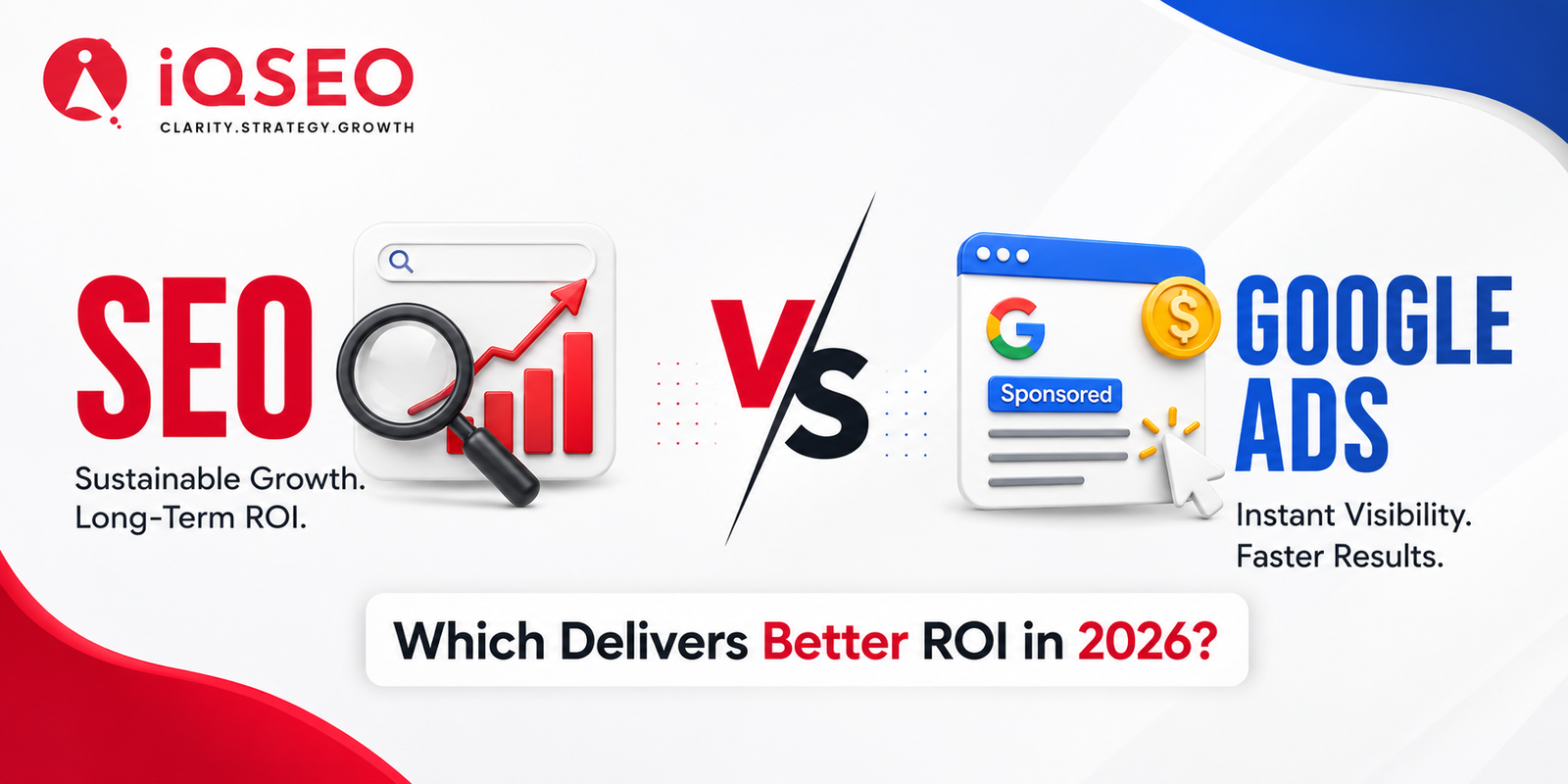
In today's competitive digital landscape, businesses are constantly looking for marketing channels that generate measurable returns. Two of the most popular digital marketing channels are Search Engine Optimization (SEO) and Google Ads. While both help businesses increase online visibility and attract customers, their approach, cost structure, and long-term return on investment (ROI) differ significantly.
As search behavior continues to evolve with AI-powered search experiences, understanding the strengths and limitations of each channel has become more important than ever. The question many businesses are asking in 2026 is simple: Which delivers better ROI—SEO or Google Ads?
Understanding SEO
SEO helps businesses increase their online presence by improving rankings in organic search results and attracting potential customers actively searching for their services. It involves optimizing website content, technical performance, user experience, and authority signals to achieve higher rankings on search engines.
With SEO, businesses can attract organic traffic without paying a fee for each click or website visit. Instead, it focuses on building long-term visibility that can continue generating traffic, leads, and conversions over time.
The key advantage of SEO is sustainability. Once a website earns strong rankings for valuable keywords, it can attract qualified visitors consistently without ongoing advertising costs.
Understanding Google Ads
Google Ads is a pay-per-click (PPC) advertising platform that allows businesses to appear at the top of search results instantly. Advertisers bid on keywords and pay when users click on their ads.
Google Ads offers immediate visibility and can generate leads from the first day of a campaign. This makes it an attractive option for businesses launching new products, promoting limited-time offers, or entering competitive markets.
However, traffic generated through Google Ads is directly tied to advertising spend. When campaigns stop, visibility and traffic often disappear as well.
Comparing ROI: SEO vs Google Ads
When evaluating ROI, businesses must consider both short-term results and long-term value.
Google Ads typically delivers faster results. Businesses can generate traffic and leads immediately, making it highly effective for short-term objectives. However, customer acquisition costs can increase over time, especially in competitive industries where cost-per-click rates continue to rise.
SEO, on the other hand, requires patience and consistent investment. While it may take several months to achieve significant rankings, the long-term benefits often outweigh the initial effort. Organic traffic continues to grow without requiring payment for every visitor, resulting in a lower cost per acquisition over time.
For many businesses, SEO becomes more cost-effective as rankings improve and organic visibility expands.
Why SEO Delivers Stronger Long-Term ROI in 2026
Several factors contribute to the growing ROI advantage of SEO:
Sustainable Traffic Growth
High-quality content and strong search rankings can generate traffic for months or even years after publication, creating compounding returns.
Increased Trust and Credibility
Users often perceive organic search results as more trustworthy than paid advertisements, leading to higher engagement and conversion rates.
Better Alignment with AI Search
As AI-powered search experiences become more common, websites with authoritative content, strong expertise, and optimized user experiences are more likely to gain visibility across traditional search and AI-generated results.
Lower Customer Acquisition Costs
Once rankings are established, businesses can continue attracting qualified traffic without paying for each click, reducing overall marketing costs.
When Google Ads Makes More Sense
Despite the long-term advantages of SEO, Google Ads remains a valuable channel in specific situations:
-
Launching a new business or website
-
Promoting time-sensitive campaigns
-
Testing new products or services
-
Generating immediate leads
-
Targeting highly specific commercial keywords
For businesses that need rapid visibility, Google Ads can provide results while SEO efforts are still gaining momentum.
The Most Effective Strategy: Combining SEO and Google Ads
The highest-performing businesses rarely rely on a single channel. Instead, they integrate SEO and Google Ads into a unified digital marketing strategy.
Google Ads can drive immediate traffic and generate quick insights into keyword performance, while SEO builds long-term authority and sustainable growth. Together, they create a balanced approach that delivers both short-term wins and long-term profitability.
This combination allows businesses to maximize search visibility, improve lead generation, and reduce dependence on any single traffic source.
Final Verdict
In 2026, the answer depends largely on business objectives. If immediate visibility and rapid lead generation are the primary goals, Google Ads offers the fastest path to results. However, for businesses seeking sustainable growth, stronger brand authority, and lower long-term acquisition costs, SEO delivers superior ROI.
Rather than viewing SEO and Google Ads as competing strategies, businesses should consider how both can work together to create a comprehensive search marketing strategy. Organizations that invest in long-term organic growth while strategically leveraging paid advertising are best positioned to achieve lasting success in the evolving digital landscape.
At IQSEO, we help businesses build ROI-driven search strategies that combine technical excellence, content authority, and data-driven optimization to achieve measurable growth in 2026 and beyond.
FAQ
1. Is SEO better than Google Ads in 2026?
Unlike Google Ads, where every click comes at a cost, SEO helps businesses attract organic traffic without ongoing per-click charges.Google Ads provides faster results, but SEO typically delivers more sustainable ROI in the long run.
2. Which delivers a higher ROI: SEO or Google Ads?
SEO generally provides a higher long-term ROI because businesses do not pay for every click. Google Ads can produce immediate leads and sales, but ongoing advertising costs can impact profitability over time.
3. How long does SEO take to show results?
Most businesses begin seeing noticeable SEO improvements within 3 to 6 months. The timeline depends on factors such as industry competition, website authority, content quality, and technical optimization.
4. Is Google Ads worth it for small businesses?
Yes. Google Ads can help small businesses generate targeted traffic and leads quickly. It is particularly useful for new businesses, local service providers, and companies running time-sensitive campaigns.
5. Can SEO and Google Ads work together?
Yes. Many businesses achieve the best results by combining SEO and Google Ads as part of a unified digital marketing strategy. Google Ads provides immediate visibility, while SEO builds long-term organic traffic and reduces dependence on paid advertising.
6. What is the main difference between SEO and Google Ads?
SEO focuses on improving a website's organic rankings through content, technical optimization, and authority building. Google Ads uses a pay-per-click model that allows businesses to appear in search results instantly by paying for clicks.