







SEO today looks very different from what it did a few years ago. Publishing a blog, adding a target keyword several times, and building a few links is no longer enough to compete consistently in search results. Google has become much better at understanding context, search intent, related topics, and how different pages on a website connect with each other.
That is why Topical Authority SEO has become an important part of a strong content strategy.
The idea is simple: instead of publishing unrelated articles whenever you find a promising keyword, build a useful collection of content around the subjects your business genuinely knows well.
This approach gives visitors more complete information and makes the structure of your website easier for search engines to understand. One of the best ways to achieve this is through content clusters.
What Is Topical Authority in SEO?
Topical authority is the depth and credibility a website develops around a particular subject.
Think about two websites competing for visibility around local SEO. The first has one general article explaining local SEO. The second has resources covering Google Business Profile optimization, local keywords, citations, reviews, local backlinks, location pages, competitor research, ranking factors, and local SEO audits.
Which one gives a reader more opportunities to find the answer they need?
Usually, it is the website that has explored the subject from multiple useful angles.
This does not mean publishing hundreds of articles just to make a website look bigger. What matters is whether your content answers the important questions people have about the topic.
When useful pages are organized properly and connected naturally, they can build stronger relevance around your core areas of expertise.
Why Is Topical Authority Important for SEO?
Google tries to match each search with content that best satisfies what the user is looking for. A website with strong coverage of a subject gives search engines more context about what that website specializes in.
It can also open the door to a wider range of organic searches.
For instance, an SEO business that only has a page targeting “SEO services” is covering a very small part of the customer journey. Potential customers may first search for keyword research, technical SEO problems, local rankings, link building, website audits, search intent, or content optimization before they ever look for an SEO company.
Creating useful content around those subjects allows the website to reach users at different stages of their research.
There is also a clear benefit for visitors. Someone reading about keyword research might naturally have questions about keyword difficulty or competitor analysis. If those resources are already available and linked from the article, the visitor can continue exploring without searching elsewhere.
That makes the website more useful rather than simply giving it more pages.
What Are Content Clusters?
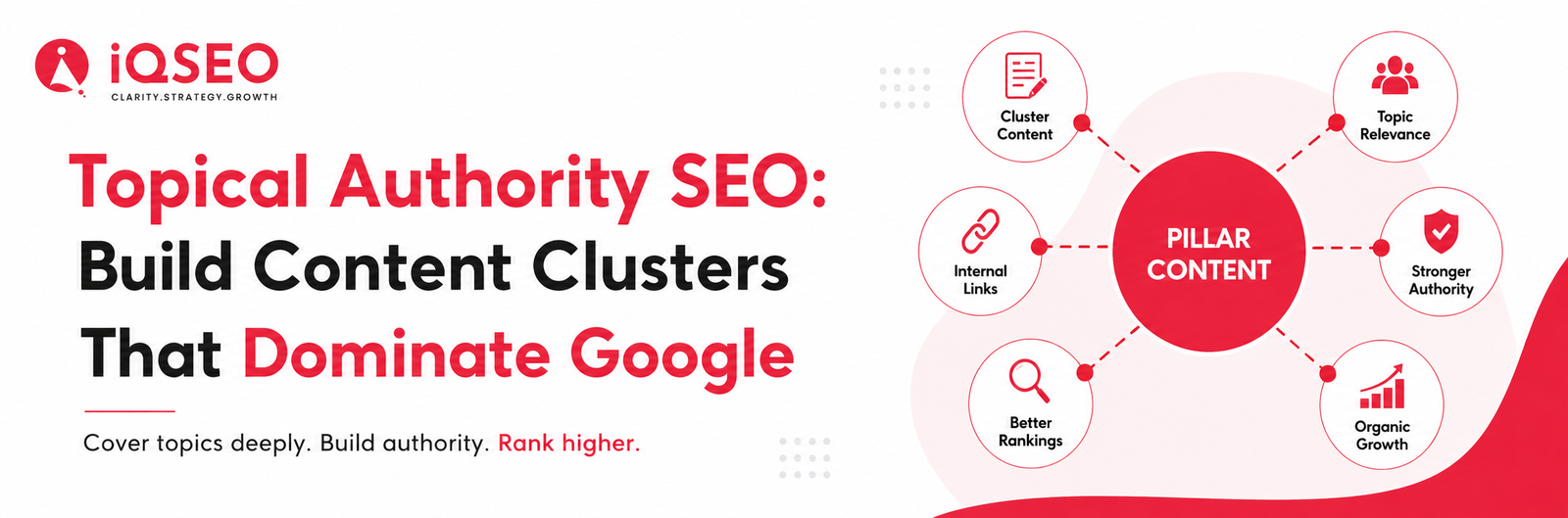
A content cluster is a group of closely related pages built around one central subject.
Most clusters have three important elements: a pillar page, supporting cluster content, and internal links connecting them.
The pillar page introduces the broader topic and its major areas. Supporting articles then provide detailed coverage of individual topics related to the main subject.
Internal links bring everything together.
For example, you could create a pillar resource called Complete Guide to Local SEO.
The supporting content could cover topics such as:
-
How to Optimize Google Business Profile
-
Local Keyword Research
-
Local Citation Building
-
How to Get More Google Reviews
-
Local Link Building
-
Location Page SEO
-
Local SEO Audits
-
Tracking Local Keyword Rankings
Rather than eight unrelated blog posts sitting in your blog section, these articles become part of one organized Local SEO resource.
How to Build Content Clusters for Topical Authority
A good content cluster starts with planning. Publishing multiple articles containing similar keywords will not automatically establish authority.
1. Choose a Relevant Core Topic
Start with subjects that have a genuine connection to your business.
An SEO company, for instance, could build clusters around local SEO, technical SEO, keyword research, on-page SEO, content marketing, link building, or e-commerce SEO.
The topic needs enough depth to support several useful pieces of content. At the same time, it should be relevant to the audience you actually want to attract.
Search volume matters, but it should not be the only reason you choose a topic. A keyword bringing the right potential customers can be far more valuable than a larger keyword with little connection to your services.
2. Look at Search Intent First
Before creating an article, understand why someone would search for that term.
A search for “what is local SEO?” comes from someone looking for information.
Someone searching “best SEO tools for small businesses” is likely comparing options.
A query such as “SEO company in Coimbatore” suggests that the user may be looking for a service provider.
These searches belong to the same general industry, but they should not all lead to the same type of content.
Mapping keywords according to intent helps you create pages with a clear purpose. It also reduces the risk of publishing several pages that end up competing against each other.
3. Research the Topic, Not Just One Keyword
Keyword research is still essential, but topical research goes further.
Once you have selected a core topic, look at the questions people ask around it. Find related searches, long-tail keywords, comparisons, common problems, definitions, and practical how-to queries.
Useful sources can include Google autocomplete, People Also Ask, Google Search Console, competitor content, customer conversations, industry communities, and keyword research platforms.
Suppose your cluster is about technical SEO. Your research might uncover subjects such as crawling, indexing, XML sitemaps, robots.txt, canonical tags, redirects, structured data, Core Web Vitals, mobile optimization, and duplicate content.
Now you have the foundation of a cluster rather than a single keyword idea.
4. Build a Useful Pillar Page
The pillar page should work as the central resource for your chosen topic.
It needs to explain the main subject clearly while introducing the areas readers may want to explore next.
A technical SEO pillar page, for example, might cover crawling, indexing, website architecture, page speed, mobile performance, structured data, HTTPS, sitemaps, and canonicalization.
There is no need to turn every section into a 2,000-word explanation. That is what supporting articles are for.
Give readers enough information to understand each area, then guide them to a more detailed resource where appropriate.
This naturally creates a structure such as:
Core Topic → Supporting Topic → Specific Question
It is simple for visitors to follow and creates a cleaner content architecture.
5. Create Cluster Content People Actually Need
Every supporting article should have its own job.
If your pillar topic is keyword research, supporting content might explain long-tail keywords, search volume, keyword difficulty, competitor research, keyword mapping, search intent, and cannibalization.
Be careful with articles that are different only because the wording of the keyword changes.
“Keyword research tips,” “best keyword research tips,” and “keyword research techniques” could potentially satisfy the same search intent. Publishing separate posts for all three may create unnecessary overlap.
Where the intent is similar, one stronger resource is usually more useful than several thin ones.
6. Use Internal Links With a Purpose
Internal linking is what turns individual pages into a connected cluster.
A pillar page can point readers toward relevant supporting resources. Cluster articles can link back to the main guide and to other articles when there is a genuine connection.
The anchor text should also make sense.
Instead of adding a vague “click here,” something like “competitor keyword analysis” immediately tells readers what they will find on the next page.
Do not force links into every paragraph. Internal linking works best when the next resource genuinely helps the person reading the page.
7. Bring Experience and Trust Into the Content
Covering a topic widely is useful, but depth without quality will not get you very far.
Your articles should demonstrate real understanding. Practical examples, clear explanations, first-hand observations, case studies, credible sources, original data, and updated information can make content more valuable.
This also supports the principles behind E-E-A-T: Experience, Expertise, Authoritativeness, and Trustworthiness.
Where relevant, show who created the content, keep company information transparent, reference reliable sources, and update older information.
The aim is not to fill your website with content. The aim is to make each page worth visiting.
8. Keep Improving the Cluster
A content cluster is never completely finished.
Search behaviour changes. New questions appear. Competitors improve their pages, and information that was accurate two years ago may no longer be useful today.
Review your important content regularly.
Google Search Console is especially valuable here. A page may receive impressions for searches you did not originally target. Those queries can reveal missing sections, new keyword opportunities, or even ideas for future supporting articles.
You should also check for outdated examples, broken links, orphan pages, declining rankings, and content that overlaps too heavily with another page.
Common Content Cluster Mistakes
One of the biggest mistakes is treating a content cluster as a numbers game. Publishing 30 weak articles does not automatically make a website authoritative.
Another common problem is targeting almost identical keywords with different URLs. This can create cannibalization and make it difficult to decide which page should rank.
Weak pillar pages, irrelevant internal links, outdated information, orphaned articles, and content created without a clear search intent can also weaken the overall structure.
Before publishing anything, ask a simple question: Does this page add something useful to the topic?
If the answer is no, another article may not be necessary.
Build Long-Term Topical Authority with IQSEO
Topical authority is not a quick ranking trick. It is a way of building a website that becomes more useful and organized as it grows.
At IQSEO, we develop SEO strategies around search intent, content planning, keyword research, technical optimization, and smart internal linking. The focus is not simply on ranking one keyword, but on building organic visibility across the searches that matter throughout a customer's journey.
When businesses consistently provide useful answers around their areas of expertise, their websites have a stronger foundation for sustainable organic growth.
Conclusion
Topical Authority SEO changes the way you approach content.
Instead of asking, “What keyword should we write about next?” start asking, “What does someone interested in this topic need to know next?”
Choose a subject that matters to your business, build a strong pillar resource, create genuinely useful supporting articles, and connect them with natural internal links. Then keep improving those pages as search behaviour and your industry evolve.
A strong content cluster does more than target keywords. It creates a resource people can explore, helps organize your website, and gives search engines clearer context about the subjects your business knows best.
Frequently Asked Questions
1. What is topical authority in SEO?
Topical authority describes how thoroughly and reliably a website covers a particular subject. It develops over time through useful content that addresses related topics, questions, and search intents.
2. What are content clusters in SEO?
Content clusters are groups of related pages organized around a central pillar topic. Supporting articles cover specific areas of that topic and connect through relevant internal links.
3. Can content clusters improve Google rankings?
Content clusters can support organic visibility by creating clearer topic relationships, improving internal linking, covering more relevant searches, and helping visitors find useful information across the website.
4. What is the difference between pillar and cluster content?
A pillar page introduces a broad subject, while cluster articles explore specific parts of that subject in greater detail. Together, they create an organized content structure.
5. How many articles should a content cluster contain?
There is no ideal number. A cluster should contain enough content to address the important searches and questions around the topic without creating unnecessary or repetitive pages.
6. Why is internal linking important for topical authority?
Internal links connect related resources, guide visitors toward useful information, and provide search engines with additional context about relationships between pages.
7. How long does it take to build topical authority?
There is no fixed timeframe. Progress depends on competition, existing website authority, content quality, technical SEO, backlinks, publishing consistency, and how effectively existing content is maintained.