






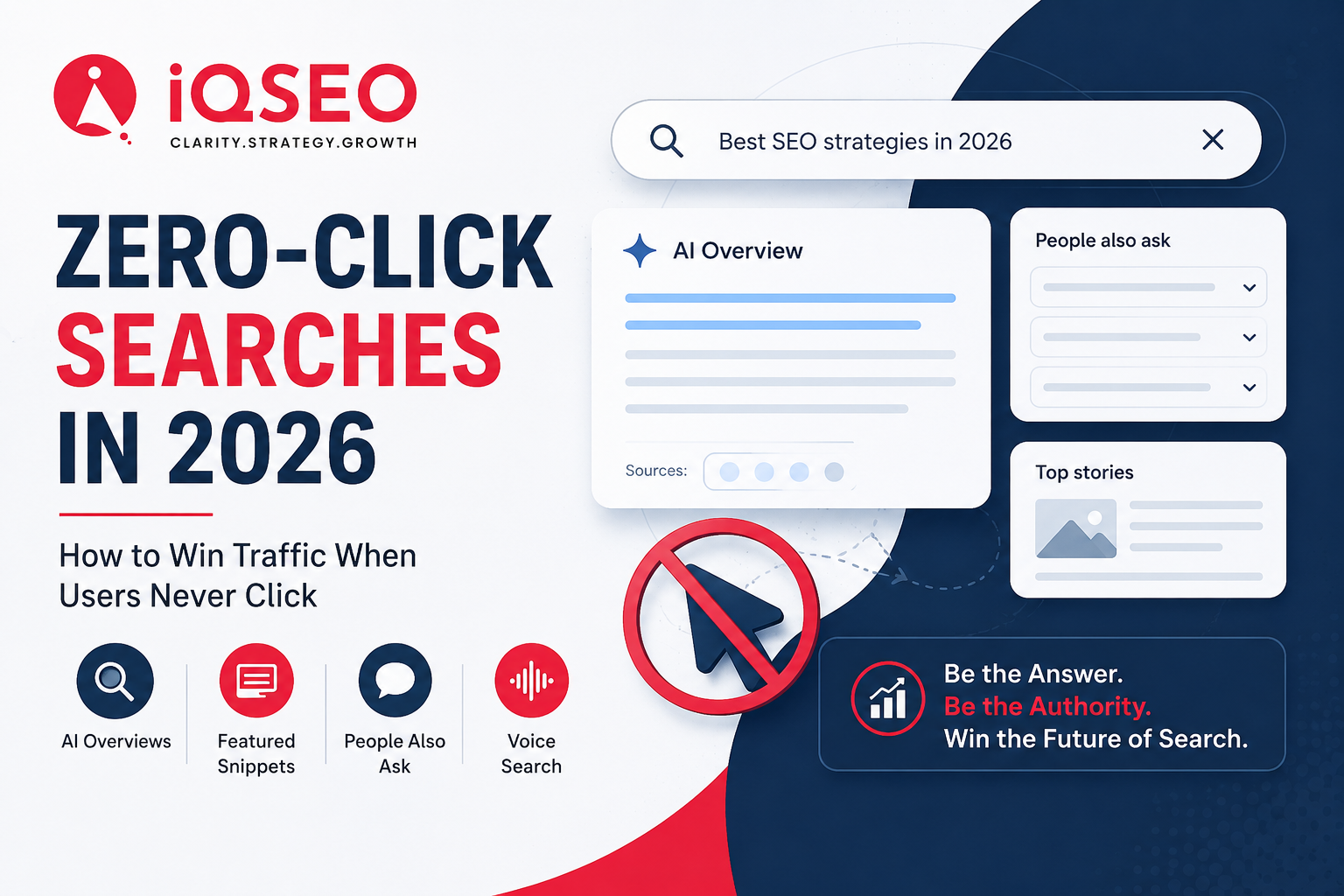
Online search has evolved rapidly over the last two years. Securing the #1 position on Google no longer guarantees consistent website traffic. In 2026, users often receive complete answers directly on the search results page through AI Overviews, Featured Snippets, Knowledge Panels, People Also Ask sections, and voice assistants. Many searches now end without the user ever visiting a website. This type of search experience is called a Zero-Click Search.
For businesses and marketers, this doesn't mean SEO is dead. It means SEO has evolved. Success is no longer measured only by clicks but also by visibility, authority, and how often your brand becomes the trusted source that AI search engines choose to reference.
In this guide, we'll explain what zero-click searches are, why they matter in 2026, and how businesses can still grow their organic traffic by adapting to modern SEO strategies.
What Are Zero-Click Searches?
A zero-click search happens when users find the information they need directly on the search results page without clicking any website.
For example, if someone searches:
"What is Technical SEO?"
Google may display an AI Overview that explains the answer immediately. The user reads it and leaves without opening any website.
Similarly, searches like:
-
Weather today
-
IPL score
-
Currency conversion
-
Business opening hours
-
Definitions
-
Simple how-to questions
often provide instant answers within Google itself.
AI-powered search experiences have accelerated this trend, making zero-click searches one of the biggest SEO challenges—and opportunities—of 2026. Industry research shows that a majority of informational searches now end without a website click, driven by AI-generated summaries and rich search features.
Why Are Zero-Click Searches Growing So Fast?
Several developments have changed how people search online.
1. AI Overviews
Google's AI Overviews summarize information from multiple trusted sources, allowing users to get quick answers instantly.
Instead of reading five blog posts, users often receive one summarized response.
2. Better Search Experience
Google's goal is simple:
Deliver the best answer as quickly as possible.
The less time users spend searching, the better the experience.
3. Voice Search
Voice assistants rarely provide ten website links.
Instead, they speak one direct answer.
This naturally creates more zero-click interactions.
4. Mobile Usage
Most users now search on smartphones.
Quick answers save time and reduce unnecessary navigation.
Does Zero-Click Mean SEO Is Dead?
Absolutely not.
Traditional SEO focused on rankings.
Modern SEO focuses on visibility.
Even when users don't click immediately, appearing inside AI-generated answers builds:
-
Brand awareness
-
Authority
-
Trust
-
Future branded searches
-
Higher conversion opportunities
Businesses that regularly appear as trusted sources build credibility with users even before they visit the website.
The New Goal: Become the Source AI Chooses
AI search engines don't randomly select websites.
They prioritize content that demonstrates:
-
Expertise
-
Experience
-
Authority
-
Trustworthiness
-
Structured information
-
Fresh content
-
Strong topical relevance
This is why E-E-A-T has become even more important in 2026. AI systems increasingly favor well-structured, trustworthy, and intent-focused content over keyword-heavy pages.
10 Proven Strategies to Win Traffic from Zero-Click Searches
1. Answer Questions Immediately
Instead of writing long introductions, answer the user's question within the first 50–100 words.
Example:
Question
What is Local SEO?
Answer
Local SEO is the process of optimizing your business to appear in local search results such as Google Maps, Google Business Profile, and location-based searches.
This improves your chances of being featured in AI-generated search results.
2. Write for Search Intent
Don't create content only around keywords.
Understand why users search.
Common search intents include:
-
Informational
-
Commercial
-
Transactional
-
Navigational
Content that matches intent performs better in both Google Search and AI-powered results.
3. Structure Content Clearly
AI systems understand organized content more effectively.
Use:
-
Clear H2 headings
-
H3 subheadings
-
Bullet lists
-
Numbered steps
-
Tables
-
FAQs
A clean structure makes your content easier for AI systems to interpret.
4. Build Topical Authority
One blog isn't enough.
Create multiple articles around related topics.
For example:
SEO Hub
-
Technical SEO
-
Local SEO
-
E-commerce SEO
-
AI SEO
-
GEO
-
AEO
-
Content Marketing
-
Link Building
-
SEO Audits
When Google sees complete topic coverage, it considers your website more authoritative.
5. Optimize for AI Overviews
AI prefers concise, factual answers.
Use:
-
Definitions
-
Statistics
-
Lists
-
Comparisons
-
Pros and Cons
-
Step-by-step guides
These formats are frequently selected for AI-generated summaries.
6. Add Structured Data
Schema markup helps search engines understand your content.
Important schemas include:
-
Article
-
FAQ
-
Organization
-
Breadcrumb
-
Person
-
Local Business
-
Service
Structured data increases your chances of being featured in enhanced search results.
7. Strengthen Your Brand
Brand recognition matters more than ever.
Publish consistently.
Earn mentions from reputable websites.
Collect genuine customer reviews.
Be active across platforms.
Strong brands are more likely to be cited by AI systems.
8. Improve Content Quality
Avoid publishing generic AI-generated articles.
Instead, include:
-
Original insights
-
Real examples
-
Case studies
-
Expert opinions
-
Updated statistics
-
Practical advice
Unique content stands out in both traditional and AI-driven search.
9. Keep Content Updated
Search engines prefer fresh information.
Review important articles regularly by:
-
Updating statistics
-
Refreshing screenshots
-
Adding new sections
-
Improving internal links
Regular updates signal that your content remains relevant.
10. Measure More Than Traffic
Traditional SEO metrics are no longer enough.
Track:
-
Brand impressions
-
AI Overview visibility
-
Search Console impressions
-
Branded searches
-
Engagement
-
Leads
-
Phone calls
-
Form submissions
Visibility across AI experiences is becoming just as important as raw traffic.
Common Mistakes to Avoid
Many websites still rely on outdated SEO practices.
Avoid:
-
Keyword stuffing
-
Thin content
-
Clickbait titles
-
Duplicate pages
-
Ignoring E-E-A-T
-
Publishing without schema
-
Writing solely for rankings
Modern SEO rewards usefulness, clarity, and credibility.
How IQSEO Helps Businesses Stay Visible in AI Search
At IQSEO, we help businesses adapt to the future of search through a combination of traditional SEO and AI-focused optimization.
Our services include:
-
AI Search Optimization (AEO & GEO)
-
Technical SEO
-
Local SEO
-
Content Strategy
-
E-E-A-T Optimization
-
Schema Markup
-
SEO Audits
-
AI Overview Optimization
-
Google Business Profile Optimization
-
High-quality Content Marketing
Our goal is simple: help your business become the trusted source that search engines and AI platforms rely on.
Final Thoughts
Zero-click searches are changing how people discover information, but they are not the end of SEO. They are pushing businesses to create content that is more useful, trustworthy, and easy for both users and AI systems to understand.
Instead of chasing clicks alone, focus on becoming the best answer. When your content consistently solves real problems and demonstrates expertise, search engines are more likely to feature your brand in AI Overviews, voice search, and other answer-first experiences.
The future of SEO belongs to businesses that prioritize authority, user intent, and structured, high-quality content. By adapting now, you can build lasting visibility—even when users don't click immediately.
If you're ready to future-proof your SEO strategy, IQSEO can help you optimize for both traditional search and the AI-powered search experiences shaping 2026 and beyond.
Frequently Asked Questions (FAQs)
1. What are zero-click searches?
Zero-click searches are search queries where users find the information they need directly on the search results page without visiting a website. Features like AI Overviews, Featured Snippets, Knowledge Panels, and People Also Ask boxes provide instant answers, reducing the need for clicks.
2. How do zero-click searches affect SEO?
Zero-click searches can reduce website traffic for informational queries, but they also create new opportunities for brand visibility. Businesses that optimize their content for AI Overviews and featured search results can increase their authority and attract qualified visitors when users need more detailed information.
3. How can I optimize my website for zero-click searches?
To optimize for zero-click searches, create high-quality content that answers user questions clearly, use structured headings, implement schema markup, optimize for featured snippets, follow E-E-A-T principles, and publish content that aligns with search intent.
4. What is the difference between traditional SEO and zero-click SEO?
Traditional SEO focuses on improving website rankings and increasing clicks, while zero-click SEO focuses on making your content visible within AI-generated answers, featured snippets, and other search result features. The goal is to build brand authority and visibility, even when users don't immediately visit your website.
5. Why is E-E-A-T important for zero-click search optimization?
E-E-A-T (Experience, Expertise, Authoritativeness, and Trustworthiness) helps search engines identify reliable content. Websites that demonstrate strong E-E-A-T are more likely to be referenced in AI Overviews, featured snippets, and other zero-click search features.
6. Can businesses still generate leads from zero-click searches?
Yes. Although users may not click immediately, appearing in AI Overviews and other search features increases brand awareness and trust. When users are ready to make a purchase or need more detailed information, they are more likely to search for your brand directly and become qualified leads.